A perspective on old comics, new graphic novels, pulp magazines, tabletop roleplaying games, science fiction, fantasy, movies, and some other facets of geek culture.
So, follow me here: a few nights ago, Wonder Wife and I watched The Rocketeer, the 1991 movie based on the classic Dave Stevens pulpy comic book series (that had several homes and incarnations in its all-too-brief run). The movie is pretty goofy, more matinee fun than anything, and there are some great turns by folks like Jennifer Connelly, Alan Arkin, Timothy Dalton, and Paul Sorvino (and a pre-Lost Terry O'Quinn as Howard Hughes) as they support Billy Campbell as the high-flying hero.
Anyway, the main muscle for the bad guys is Lothar, a giant, hulking thug in a porkpie hat, played by actor Tiny Ron Taylor:
IIRC, Lothar wasn't in the original series (although he was apparently added to a later adventure created after the movie was made). The character is clearly modeled on The Hoxton Creeper, a character played by actor Rondo Hatton in the 1944 Sherlock Holmes movie The Pearl of Death:
Now, Tiny Ron Taylor, the movie Lothar, was a big guy - seven feet tall according to his own website - but he was just a guy who gets his clothes at the Big & Tall Shop and was pretty average looking. Here's Tiny Ron without his Lothar makeup:
But Rondo Hatton suffered from acromegaly. This pituitary gland disorder is sometimes associated with gigantism, but surprisingly for his image, Hatton was only average height - maybe a little tall, but certainly not Tiny Ron size. The effects of his condition can be seen more in his facial features, which were distorted by the disorder - his Creeper visage was not done with prosthetics. Here's a typical publicity shot:
So as I was researching all of this after watching the movie, a little bell went off. Remember my review of Different Ugliness, Different Madness from a few weeks ago?The French graphic novel about two lost souls finding each other?Here's their first meeting from that story:
Let's zoom in on that last panel:
Look familiar?
Now, that there are hommages in Paul Stevens's work is nothing surprising - his stuff was practically wall-to-wall period references and riffs. But why would a French cartoonist working in 2005 use the image of a Hollywood actor who had died in 1946 as the model for his forlorn and alienated character? I can't find a connection between Hatton and France besides his having served there in the First World War. Did Marc Males Google acromegaly and find a picture of Hatton? Or had he watched The Rocketeer too?
Or is is just that all of us nerdy types, whether creators or audience, are all drawn to the same stuff?
So, I recently tripped over a couple of articles on a movie blog, one called 5 Comic Book Adaptations That Got It Just So Wrong and one called 5 Comic Book Adaptations That Got It Just So Right. You can find these articles on your own if you like, but I wouldn't waste a lot of time looking for the, since they should have just been combined into a single essay titled Some Superhero Movies I Liked and Didn't Likefor a Variety of Reasons that you could then skip at your convenience.
In neither article does the author ever give us a clear sense of what just so right and just so wrong actually mean. Some of the so wrong movies deviate from what he considers the core concepts of the character; but so do some of the so right ones. His responses to the various movies and television shows are so idiosyncratic that the essays become even less useful than a typical review and are all the more disappointing because of the promise they held out for some greater meaning than a simple thumbs up or thumbs down. There's no core thesis to be found. (Is my English composition teacher showing?)
To balance the ecosystem of the comixweblogosphere, I am going to offer my Superhero Comic Book Adaptation That Got It Right, and back it up.
First of all, to define terms: got it right means a movie closely matched the spirit and sensibility of the source material, visually, narratively, and thematically. It does not mean a slavish devotion to continuity or canon, but rather the evocation of the same sort of emotional response in the viewer of the movie that a reader of the comic would have.
In my mind, the movie that has succeeded best at this specific objective is...
Now, I know this 1984 Salkind spin-off doesn't get a lot of love (even though it gave us the wonderful Helen Slater), and I'm not arguing that it is the best superhero movie ever or even that it is a good movie. What I am saying is that this is the most faithful translation of a comic's style and mood from page to screen.
You see, in the early eighties, The Daring New Adventures of Supergirl was being written by Paul Kupperberg and illustrated by Carmine Infantino. Kupperberg was a former fanzine publisher who became a DC stalwart in the Julie Schwartz days; his stories were typical of Bronze Age DC: not as goofy as Silver stories, overly earnest in their "relevance," and about as hip as Happy Days. Infantino, after being removed as Publisher of DC, was back to work as an artist, replacing his earlier delicate style with lines that embodied the ideas of brio and gusto and elan. Here's an example of their collaboration, from a DC promotional comic:
"Halston I'm not, Kara..." Oh, Kupperberg, you wag!
Here are some more samples from the comic:
I got news for you, babydoll - this ain't Watchmen. These comics are big, they're bright, they're bold - they're comic book-y.
And they comprised the model for the movie that came out a year or so later. Here's the trailer from the movie, which matches my memory pretty closely (except I am sure there was a much higher ratio of Peter O'Toole). I think you can see where the filmmakers took their cues:
As my cinematic namesake would say, am I wrong? Sure, they changed a lot of stuff - that giant robot became a piece of construction equipment - but the female antagonists, the forced humor, the awkward romantic element, and the whole tone and timbre are spot on. I mean, Faye Dunaway even looks like she was drawn by Carmine Infantino.
I will stand by this assertion: over 30 years ago, Supergirl was the movie that got it right.
Of course, the greatest single performance to get it right occurred 18 years later, but that's another post.
Returning home from service in the Korean War, Lucas Doolin, a resident of the rural mountain area of southern Kentucky, made his living delivering liquor that had been distilled by his father without proper license or any government approval. He was one of several such drivers in the region around Knoxville, Tennessee so engaged.
On April 1, 1954, with increasing pressure from both federal law enforcement agents and organized crime elements from out-of-state, Doolin set out to make what his father had determined would be the last delivery from their distillery.
Doolin took a circuitous route to his intended destination in order to evade apprehension by law enforcement officers. Although Google mapping services show a distance of 125 miles and a projected elapsed time of two and three-quarter hours for the trip, it is likely that Doolin actually traveled further, since he frequently left the main highway and took roads that even angels feared to tread in his efforts to avoid police roadblocks. Nonetheless, he may have actually made the journey in less time, since thunder was his engine and from the very start of the trip he was revving up his mill.
An unnamed federal agent had assured Doolin he would arrest him as sure as fate, but by the end of the evening neither party to the encounter had succeeded. Before he could make his delivery, Doolin died in a vehicle accident when his car left the road while traveling at an estimated 90 miles per hour. Although the law swore they'd get him, the devil got him first.
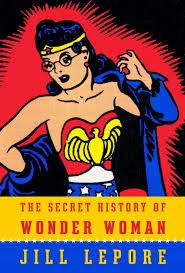
1. First of all, this book by Jill Lepore is not a secret history of Wonder Woman in the sense that it tells the story of Diana of the Amazons, Wonder Woman, superhero, associate of Superman and Batman, member of the Justice League, &c. This is the secret history of the creation of that character: how the motivations and values and experiences of William Moulton Marston and his associates and his unusual, cobbled-together family all fed into the Wonder Woman mythos. There are call-outs to the comics themselves, of course, and quite a few samples of four-color panels among the illustrations, but the book is more in the nature of an author biography and less an exegesis of an oeuvre; more Will in The World than Asimov's Guide to Shakespeare.
2. And this is not the secret history of Wonder Woman's creator that every comics fan thinks they know. Lepore covers the usual bases: Moulton was a psychologist (well, yes, technically - but with a much more checkered academic profile than we think); Marston was the inventor of the lie detector (well, yeah, kinda - he invented one of them); Marston was a polygamist with two wives (well, yeah, sorta - more accurately, he and his wife shared an additional wife); Marston was into dominance and submission (well, yeah, you could say that - but not in the way that most people imagine). Where the book breaks new and exciting ground is in exploring the heretofore unexamined aspects of Marston's adventures: his identity as an entrepreneur, almost an impressario; his early connections to the suffragist and feminist movements; his close connection to Margaret Sanger, the slightly tarnished saint of the movement that would become Planned Parenthood; and how he used his total control over the creation, writing, and presentation of Wonder Woman to forward his philosophies.
3. In fact, this is not really a comic-book-book. Lepore was apparently not a comics fan, someone seeking to unearth the treasure of her favorite fandom. She is a professor of American History and a cultural historian; she has written on the American experience through the lenses of language, the concepts of life & death, Colonial era war, post-independence race relations, and the writings of Ben Franklin's sister. She brings the same scholarship and seriousness of purpose to her inquiry into Marston. Her non-fan's take on the sections delving into the comic book subculture brings a fascinating perspective and sensibility and only occasionally misses a nuance. This book deserves to be shelved with David McCullough or Doris Kearns Goodwin as much as with Douglas Wolk or Scott McCloud.
4. Speaking of scholarship, the research evident in the book astonishing. The work of a historian - the sifting of documents, the collation of information, the verification of sources - is palpable on every page. This is a virtuoso demonstration, a talented scholar marshaling primary sources to build a coherent picture of obscure events and adding insightful analysis to make meaning. I am tempted to use this as the model text for my research writing class: you can almost inhale the scholarship.
5. Notwithstanding its rigor, the book is a wonderful read. I read mostly non-fiction these days, and much of it can be a slog; this book was quite the opposite. I took it as a vacation book on a trip to California and I could not have been more pleased. Lepore's prose is cogent and springy and occasionally charmingly idiosyncratic. Besides learning a lot, I enjoyed the book immensely. Read it and see for yourself.
So, as I reported about a week ago, I had a great visit to Sterling Silver Comics (Mike Sterling, Esq., Prop.) when I was down in California for Winter break; the idyllic sojourn was marred only by my forgetting there was a Part Two to the story in the X-Men comic that I purchased specifically for one panel by Werner Roth - and of course that panel is not in Part One.
Undaunted, I made mail-order arrangements with the Mikester for the second issue; it was easy, since he's such an Ebay maven and has all the ducks particular that kind of exchange nicely lined up. And today, a package was delivered to my door by a uniformed representative of the federal government.
I want to digress a moment to say that the package was pretty impressive. It was a nice stiff manila envelope with a professional mailing label; inside was a thick backing board and a thinner protective cardboard sheet; and inside that the poly-bagged comic was wrapped in another plastic bag for added protection. Nice.
When I got the issue out, I realized the cover was cooler than I remembered - here it is scanned clear:
The story concerns Count Nefaria's (um, okay) attempt to revive the criminal organization The Maggia (cut it out, Stan!) and use the captive X-Men as pawns in a plot extort one hundred million dollars (that's three quarters of a billion in today's money) from the U.S. government by holding Washington, D.C. hostage in a weird transparent dome. The Count's lieutenants are The Eel, Scarecrow, The Porcupine, Plantman, and The Unicorn. (I thought this group had a name, but if they ever did, it came later.)
As achingly Silver-Age as much of the story is, this installment is as action-packed as promised on the cover, with lots of teamwork from both the X-Men and the Five Bad Guys as they battle through the capital. The Army steps in, apprehending super-heroes and super-villains alike (which was actually pretty reasonable), and that leads to the panel that I have remembered for decades: the not-capture of the Bad Guys.
The panel is almost exactly as I remembered; I had the figures a tiny bit smaller in the frame, but otherwise the layout and composition were just as I recalled. I don't know why this panel, of the thousands upon thousands that have passed my eyeballs, is among those that have burned that flashbulb memory into my brain. There's just something about the almost pictographic arrangement and the hyper-expository dialogue that is totally charming. It's almost like old-school filmmaking when they would interrupt a scene to freeze frame and zoom in and highlight with arrows or other markers the details of a scene before letting it resume speed and play out; I get that same explainer feeling with this.
It must have made an impression of some kind. And now I have it again.
So, in addition to the wonderful French graphic novel I described here, I found other stuff at that previously-unvisited-by-me comic shop, some back issues and some new. Overall, I was... underwhelmed.
I grabbed four of the Before Watchmen number ones, just to see what all the hullabaloo was about. There was hullabaloo, wasn't there? These seemed to drop off the radar pretty quickly. I guess they ran their six or four issues and got collected, but it sure didn't make a splash in my corner of the world.
Does anybody remember the 1983-season television series Casablanca that was a prequel to the classic movie? Anybody? No? Well, I felt about these books the same way I felt about that series. I worry whenever I agree with Alan Moore about anything, but I am not sure why these exist.
Tiny saving grace: Darwyn Cooke's vision of Silhouette:
So, this should have grabbed me, if anything did: a pulpy re-imagining of the JSA with some of my favorite characters, and a shot of Doc Fate with twin forty-fives on the cover - shades of The Spider!
But Society of Super-heroes did not engage me. First of all, I couldn't get the whole Multiversity thing - the comic shop guy tried to explain it to me, but either he didn't do a good job or I'm losing my capacity for Big Events, or both. Besides that, characters were introduced into the story in very off-hand ways, as if I was supposed to already know who they were, and the conflict was more of that generic crossing-dimensions-to-conquer-another-universe stuff, and I'm sorry, but those tropes are just so tired and abstract I can't connect to them anymore. Whatever happened to stories about heroes trying to save a life, or win a battle, or stop a catastrophe involving people we had learned to care about instead of millions of faceless masses that are supposed to evoke some kind of vague empathy?
Is it okay to say I didn't like this all that much? I know it's a whole new direction, and I am glad that a woman named Babs is drawing Batgirl, but maybe I just have to deal with too much hipster culture in my real life to want to visit with the hipsters in Burnside. And has Batgirl been doing that eidetic memory, they've-worn-it-out-on-Sherlock-already thing for very long? I don't remember that being part of what she did, but maybe it was an outgrowth of her Oracle days. I do love the character - a couple of years ago I bought and read all nine issues of this and thought it was wonderful. Maybe I'll wait for the first trade and give it another shot; in the meantime, a colleague was fascinated by the concept so I'll lend this issue to her.
Tiny saving grace: the abundant use of DC's traditional trademark pseudonyms: Hooq for Tinder (or Hinge), Snapgab for Snapchat, and some kind of unnamed not-Facebook. I love that stuff.
Just so this is not all downer, I did buy one thing that was cool:
Now, he is a Thark! Nobody could do Barsoon like Murphy Anderson, and all of the DC John Carter stories (by Anderson and by others) have been collected. It's worth picking up.
Different Ugliness, Different Madness by Marc Males
Published byHumanoids/DC Comics, 2005
1. This 5 x 5 review also has a late to the party tag: apparently it was part of a short-lived DC Comics venture into publishing French graphic novels about ten years ago; I found it in the mark-down bins of a comic shop while I was waiting to take Wonder Wife to her birthday dinner last month. I picked up several sale items that evening and this was the best of the lot, by far.
2. This is a comic that has the feel of a French art film: slow-moving, quiet, and living in its details. It tells the story of two lost - or at least displaced - souls encountering one another in rural 1930s America, and its narrative is driven by small steps, tiny gestures, and unhurried interactions as opposed to action and conflict. There is a story arc, and the narrative structure includes flashbacks and flash-forwards, but as a reader I was less interested in rushing the plot forward and more interested in just watching how these people would behave as their circumstances unfolded.
3. But this is not a movie, it is a comic, and it is a wonderfully technique-driven one. You could use Different Ugliness, Different Madness as a course text to accompany Scott McCloud's books: excellent controlled and effective examples of the six forms of transition from Understanding Comics and the five choices from Making Comics seem to jump off the page. Males makes comics the way Hitchcock or DePalma make movies: with a thorough understanding of exactly what strings they are pulling to manifest their vision. And we relish experiencing every manifestation of their craft.
4. One odd note: I don't know if this was part of the original art design or something that happened in the translation process, but the lettering is smaller than it needs to be for the size of the word balloons. The result is a proportionality that reads more like whispering in most mainstream comics, but that is clearly not the intent, for it is used consistently even when it is obvious that voices are louder. It took a while to get used to, but then it just reinforced the feeling of an old movie.
5. The French idea of what a Depression-era American farmer looked like seemed a little off to me, but I am a city boy, so what do I know.
Si vous rencontrez cette bande dessinée, l'acheter!

.jpg)