Showing posts with label justice league. Show all posts

Saturday, June 23, 2018

5 x 5 movie review: Justice League


1. So, right off the bat (heh) I am going to say that I liked this a lot more than I had expected to. Based on a lot of stuff I had heard, and my general disappointment with the way DC has been handling its movie properties,  I didn't rush out to see this in theaters, but watching it at home on our new fancy-schmancy HD TV, I had a ball. Of course, I would have liked to have seen the Original Seven, but one thing I realize is that the comic book version of a thing and the movie version of a thing are not the same thing, and that's okay. It's not hard, really; just think of it as an Elseworlds. And on that level, this was a fine superhero movie.

2. Even if I am okay with Cyborg in the Justice League (which honestly still feels a little weird given his connections in my mind with the Teen Titans), I was not down with his angular, multi-faceted chrome appearance: it just seemed way too fussy. I had a similar response to Flash's segmented and wired outfit; I got the in-story explanation but it still had an overall clunky effect. On the other hand, I thought "The Aqua-man" look was a great interpretation.

3. I often go on about how this type of movie often gets too big for my tastes, how the stakes and the action are unnecessarily high; I didn't have that problem with this movie for two reasons. The first is that the Justice League, both in the comics and in this movie, was formed specifically to deal with world-threatening events; it is pretty much their brief. The second reason may seem like a technicality, but I think it is important: the League's mission was not to fight off an entire invasion, but to eliminate a device that would have made the success of that invasion a guarantee. The target, the goal, the macguffin if you will, was graspable and manageable.

4. The movie was also appealing to me for how much it captured the feel of the animated series - for example, the use of parademons to give Batman something to fight  while the heavier hitters fight the big bad.

5. Am I the only one who didn't notice Henry Cavill's CGI-ed out mustache?


Closing with this image just because I liked it so much.

Thursday, August 29, 2013

Script-Post

So, over on Talent Not Guaranteed, I just unleashed unveiled the new project that will take a year or so to complete: a panel-for-panel re-do of Justice League of America #200, similar in spirit to Gus Van Sant's shot-for-shot remake of Hitchcock's Psycho, but maybe closer in skill and execution to the legendary Raiders of the Lost Ark: The Adaptation.

This project is actually an off-shoot of a thought experiment I have had for some time; it focused on JLA #200, but only because that was the comic I had to hand when the idea came. Regardless of the source material, I think it would be an interesting exercise.

The first step is to take a comic book story and have a third party write a (DC-stye as opposed to Marvel-stye) full script -- sort of reverse-engineering the script from the finished product. This in itself would be a useful exercise in exploring the conventions of comic scriptwriting and the nature of the collaboration between writer and artist. The next step is to take the finished script and give it to a new artist, one who has never seen the source material. That artist then illustrates the story according the full script, interpreting the writer's words and direction and actualizing them. Finally, we compare the second version with the original version, examine the differences, and try to see where the influence of the writer and that of the artist can identified.

I'm not sure that this experiment isn't already being done somewhere, although perhaps it has more appeal to critics than creators - adaptation is often a useful lens for literary analysis, but maybe the talent is less interested in this than the audience.

In any event, it is that thought experiment that inspired my latest exercise. We'll see how it goes as I slog through. Probably something like this.


Wednesday, June 5, 2013

I am Silver Age, sir. We embrace technicalities.

So, my pal Richard Bensam commented on the other story that was in the  JLA Giant that contained the story I featured two posts ago. I'd like to talk more about that second story, "Journey into the Micro-World," and not just because it features the Protectors of Starzl, my long-time favorite obscure characters, but because Richard said the story "provided a powerful metaphor of crippling self-doubt [he's] recalled more than once over the years."


Here's the set-up: The JLA is brought to the alien world of Starzl to defeat their android defense team, the Protectors, before their bad radiation destroys the Starzlians. (Big design flaw, there.) The only problem is that, as the Protectors tell it, the radiation makes them unbeatable; this seems to be the case as the JLA  gets summarily whupped on land, on the sea, and in the air. 

Then they suss it out:


How? Well, see, what the radiation does (besides eventually kill you) is make you believe whatever it is you're told. So as each hero expressed doubt about the ability of the others to succeed, they internalized that doubt, and so failed at the task. This is a paradigmatic example of the kind of silver-age puzzle-piece that made superheroes work for victory rather than merely unleash their godlike powers.

In this case, the JLA recruits their "mascot," Snapper Carr, and in some hairsplitting of rabbinical  proportions, keep him from being told that the Protectors are invulnerable and help him defeat them.


"Even though I feel Ocana is invulnerable, I can still carry Snapper toward him at top speed!" Talk about your loopholes and technicalities.

Eventually the JLA prevail and turn off the radiation, and in the denouement (as other bloggers have pointed out before me) we get a rare glimpse of some super-pride :


Nobody punks the Big Red S.

I have gone on about this admittedly minor story for so long because it turns out that Richard's comment was both timely and apt. I can trace the roots and foundations of my ethical system back to several individual comics stories - and I feel the same way about this story that Richard does. Although I read it over forty years ago, whenever I find myself or someone close to me confronted with doubt, this story will come to mind, and I will ask (more or less): Is this sense of powerlessness real, or is it ultrazone radiation? Further, even if you don't feel you can succeed, is there anything really stopping you from acting anyway? Can we keep on going and not give up?

On a walk with Wonder Wife tonight we were talking about different ways of framing problems or concerns and our responses to them. She was relating a technique she had read in something by Byron Katie and we worked with it as we walked. But I was thinking: she reads this, and Thich Nhat Hanh, and other self-improvement and spiritual guidance books to help build her compass.

Me, I read comics.

Monday, June 3, 2013

Scienti-Fox

So, here's the comic story we are looking at:


And here's what Comic Vine said about it:


So I went to the copy of the story that I still have:


And, you know, they're not just whistling Dixie. Viz:


And:


I wish that some of my students' papers were cited so well.

Friends often ask me where I accumulated so much random knowledge. This story, and others like it, are some of those places. Thanks, Mr. Fox.

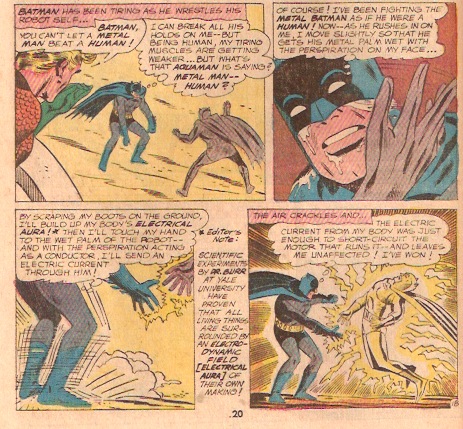
The Riddle of the Robot Justice League!  
Justice League of America #13 
National Periodical Publications
Script: Gardner Fox
Pencils: Mike Sekowsky
Inks: Bernard Sachs

Tuesday, April 23, 2013

5x5 Comics: Bwah-ha-ha redux

So, I announced last quarter at my college that I would be leaving "The Deans' Hallway" - relinquishing my position as Dean and returning (as tenure permits me) to the ranks of teaching faculty. One of my deaconal responsibilities was the supervision of the Instructional & Classroom Support Technicians - the lab techs in the science department. I had hired most of them and we had a great relationship. One of them attended Emerald City Comic Con with her brother (I think they were going just to see Patrick Stewart) and for a sort-of-going-away present to me she picked up three old comics:


Justice League #4 from 1987 and Justice League Europe #6 & #7 from 1989. I think she got them just because of the back-to-school theme of the cover shown above.

I'm not going to actually review these issues because who cares, but the perspective from 25 years or so on has some interesting aspects.

1. Someone needs to go back in time and mess with the notes of the guy inventing flexographic
printing so that it never becomes viable (like Dirk Gently interrupting Samuel Coleridge so he never finishes Kubla Khan). The image in these books are muddy and dark; readers raised on today's bright digital publications would feel like they were reading medieval manuscripts.

2. Man, there was some good drawing back in the day. These artists knew anatomy and there were no Escher Girls to be found.

3. The comics are filled with superhero action as opposed to gratuitous violence, and the sexual references are of the Three's Company, wink-wink, nudge-nudge variety. The former was a refreshing change from current comics; the latter was a change as well, but less refreshing.

4. These comics had words. Lots of words. It actually takes time to read them, there's so many words. Words that matter. Words that advance both plot and characterization as well as mood. There has been a trend to accentuate the undeniable but not universal similarities between comics language and film language to the detriment of the textual component of comics. Part of this impetus is artistic, a post-Watchmen privileging of the "realistic," whatever that is. Part of it is commercial: in the scramble to produce comics that really hope to be successful movie pitches, the visual is emphasized over the verbal. These forces combine to ensure that the textual aspect of most comics is given short shrift. It was nice to see text flowering here.

5. That said, the humor in these books did not age well.

Time-travel done. Thanks, Alex, for the memories.

Friday, March 8, 2013

Re-search: the Eastern Western

Chambara or chanbara describes a genre of Japanese cinema: specifically, what most of us would likely call "Samurai movies." The name literally refers to "sword-fighting" movies; someone saying that they like chambara would be in many ways like an American saying they liked Westerns.

I didn't know this term until I stumbled across this delightful re-envisioning of the Justice League by illustrator Alex Mitchell:


(Here's the original deviantart page and full-meal-deal on Project Rooftop)

Like other good cross-genre interpretations, the designs seek to find the key, core elements of each character and manifest them through different tropes. "A child of dragons, raised by peasants" is perhaps the most economical re-imagining of Superman to 17th century Japan: it captures his alienness, his power, and his grounding in the common man. I'll let you explore the materials yourself, and you really should; both the concepts and executions are consistently wonderful.

One illustration in particular caught my eye: that of the chambara Wonder Woman. There was some dim echo in my brain as I looked at the image, and I couldn't let it go. My google-fu was strong enough to eventually track down the source of the tickle:


I don't know where I would have run into the image on the right: 19th century Japanese woodblock artists are not usually on my radar, and this is Ishi-jo, wife of Oboshi Yoshio, one of the "47 loyal ronin," an 1848 print by Utagawa Kuniyoshi from the series Seichi Gishin Den. (Thanks, wikipedia.) The resemblance is certainly striking.

I don't know that Mitchell used this image a reference; it's likely that he did, since Ishi-jo was an onna-bugeisha, a sort-of female samurai from the upper class, a description which certainly fits the character of Lady Incredible. Whether or not this particular image was the source, Mitchell's re-creation of its sensibility, or rather his blending of that sensibility with a Western comic-book aesthetic, is extraordinary.

I just love this whole work, exquisitely detailed in idea and image, and it deserves a wide audience.