Saturday, January 16, 2016

Not to scale

So, I just watched a mini-documentary on movie trailers, and it put me in mind of a frequent complaint I have voiced: that the stakes or conflict or set-pieces in most movies have too often gotten too big and too much. It seems that we can't have a movie motivate its characters - or interest us - by anything less that the the end of the world, or something close, anyway. Any conflict is waged with doomsday devices and/or clashing hordes. Deathstars, worldwide plagues, global annihilation, armies of darkness: nobody reaches for small goals anymore, certainly not in science-fiction type movies. Everything is Armageddon.

This trend is even evident in theoretically smaller movies like action thrillers. I can recall watching stuff like The Guns of Navarone, in which the WW2 commando team must destroy one strategic gun emplacement - just one! Not save the world, or even win the war - just accomplish the mission. There was still enough drama to keep me on the edge of my seat. But now, it seems that the macguffin that the spy is after is more likely than not software that will destroy the entire internet, or the strike team has to recover a virus that could wipe out all of humanity. Do we really need a threat that big before we care about the outcome?

The bigness is present not only in the overarching plot, but in the execution of the action as well. I have talked often about how overused some CGI effects are - just because you can create huge armies doesn't mean you must create huge armies. Skirmishes can be just as exciting as battles and a fistfight as tense as clash of ninjas - more so, if we connect with the human element better.

I once saw a bit of one of those Jason Statham movies in which he drives cars real fast (I don't know which one). Some bad guy had put a bomb on his car and somehow forced him to drive away with it attached even though he knew it was there. He drives real fast, finds a construction site with conveniently stacked material, drives the car up a makeshift ramp and into a barrel roll, positioning it precisely so that a nearby crane scrapes the bomb off the undercarriage of the car, then lands the car and drives away while the bomb explodes in the air as it dangles from the crane. I felt like I was watching a Road Runner cartoon - just too much.

Just recently, I saw a bit of Meet Boston Blackie, the first in a string of 40s action films about a reformed criminal who gets caught up solving crimes (usually because people think he did whatever it was). Blackie and a woman were in a car chase, being pursued by cops or crooks, I couldn't tell which. In order to elude them, Blackie unscrews the knob from his gearshift lever, throws it back at the other car, causing a spiderweb of cracks in their windshield that impedes the driver's vision and causes him to crash into a fire hydrant. Brilliant.

That's a flick I'll have to catch the rest of. It seems more my size.


Sunday, January 10, 2016

"My name is J'onn J'onzz"


After all the years of reading comics and all the mentions of Martian Manhunter on my blog(s) since way back when and all the action figures, I have to tell you it was pretty gratifying to see this scene in Supergirl. Although the design is a little like the J'onn's Angry Asparagus Man period, it's still a great realization of the character - and David Harewood's characterization of J'onn (and his alter ego) in the show is likewise terrific.

Is it too early to start thinking about a spin-off?

Thursday, December 24, 2015

5 x 5 Movie Review: Star Wars: The Force Awakens

So, I guess this blog wouldn't be earning its keep if I didn't say something about Star Wars: The Force Awakens.

1. I saw the original movie on the second day was released - I guess that would have been May 26, 1977 - and I can still remember the frisson of excitement I felt as a movie-loving college student and SF fan at the opening scene: man, those effects blew 2001 right out the water. I liked the movie a lot, but I never became a fan in the popular sense of the word. I saw the sequels as they came out, I saw the execrable Phantom Menace later, and skipped the rest, and have never more than dipped a toe in the Extended Universe.  I understand that there are apparently people who are wee bit more invested in the franchise than I am.

2. If the intent behind of this film was for Disney to let all the aging die-hard fans see that the original look and feel of the movies is back, that they can ignore those nasty prequels, wrap themselves in the familiar, and know that everything is going to be okay, then I imagine that they have succeeded. Almost the entire movie is a callback and/or a shout out: plot elements, comic relief, set pieces, all of it.

3. I might be too harsh a critic on that front, as I had similar issues with the second Star Trek reboot movie. But I think it a fair assessment to say that even accepting that context and approach, the film does not fully exploit what should have been the emotional climax of the film involving two main characters.

4. I also wonder how this nostalgia-based strategy plays with the fans of the extended universe, who are familiar from comics, books, cartoons, and web content with a vast array of characters and settings and circumstances far removed from the original trilogy. I guess it's working out, since the movie has already made a jillion space-dollars, but it seems counter-intuitive to me.

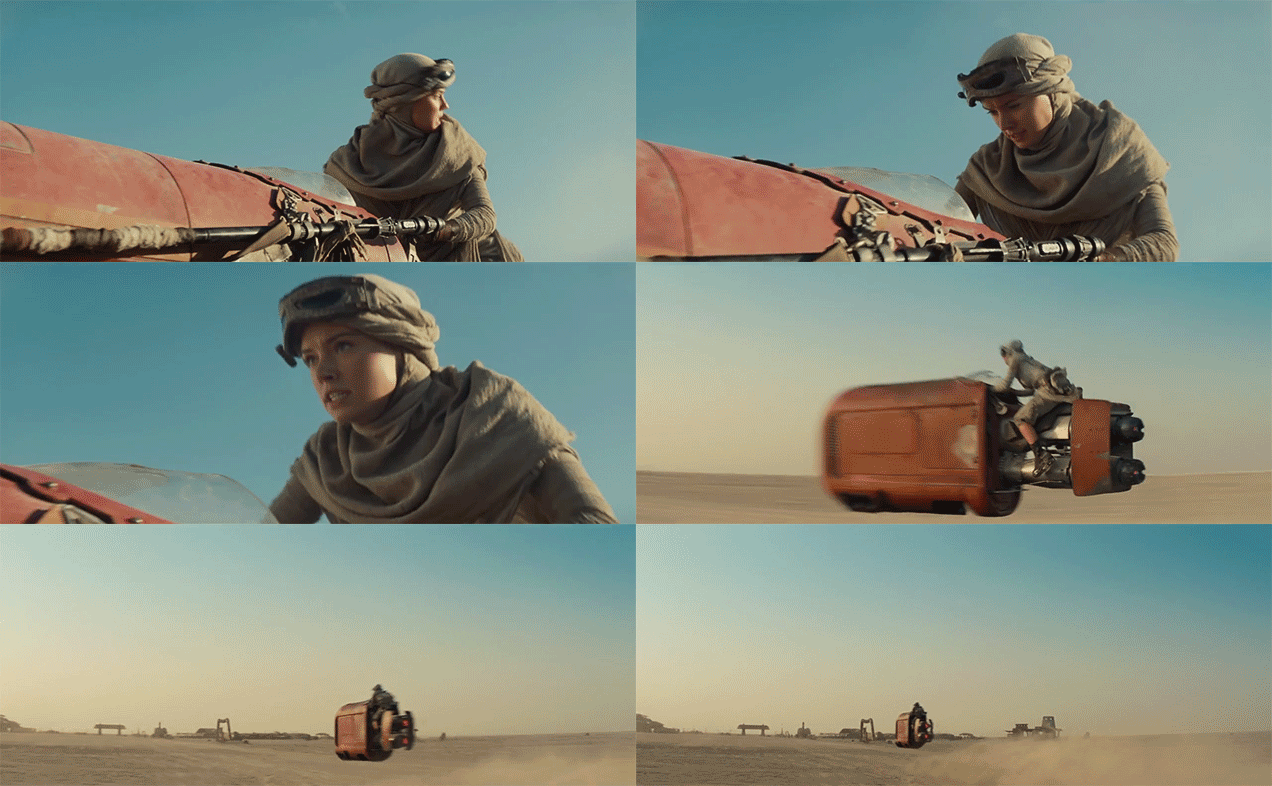
5. All that said, I will watch any movie that has Rey daringly doing some derring-do. Finn was cool and I liked him, but Rey is awesome.


Tuesday, November 24, 2015

How I sorta suck at some games

So, almost twenty years ago, I spent a Thanksgiving night transfixed by a computer game, so spellbound that I played all night and finally went to bed at 6 am Friday because it was crazy. The game was Sid Meier's Civilization; more accurately, CIV II, the second version of the game (which has since gone up to something like version Internet-6).

I was introduced to this turn-based simulation game by my pal Scott, who had no idea what rabbit hole he was leading me into. The premise behind the game is taking a civilization from an isolated tribe of villagers to a world-dominating empire by guiding them from 4000BCE to 2000CE. Your society grows through exploration, scientific advances, civic achievements, and, of course, conquest (every scientific advance brings access to new military units as well as more quotidian features). As the game-people learn more, they have access to different forms of government, each of which has different characteristics - one make people happier but be economically less inefficient, for example. The player has to balance finding scientific advances that provide material growth, keeping the population content, making peace with neighbors (or defeating them), and claiming and improving territory.

Game-time passes pretty slowly: it can take a while to span 6,000 of human development. Activity takes place on a macro-level - the player directs grand trends or research and building, for the most part. The exception is battle, which is a unit-on-unit conflict controlled directly by the layer. When a civilization spans a continent, with several dozen cities, each producing a different facility or unit, and there are workers building roads and irrigation networks, and maybe a war on a birder or two, there can be a lot to manage. Hence that all-nighter so many years ago, a product of "I'll  just play until this city has an aqueduct" which gets overlapped by "I need to play until this war in the east is over" and so on.

Well, I don't know if it was the season or what, but I decided to revisit CIV2 this year. I found a Mac OS9 emulator and downloaded a version of the old game and before I knew it, I was transported back to that duplex in Vancouver USA, ready to conquer the world.

Only it didn't quite turn out that way.

I started a game, and the computer generated the world map as usual. As my primitive tribe starting exploring, it became clear that we were on a small island. There was only room to create three cities - cities need farmland and such to support them, of course - and no more exploration to be done until we discovered seafaring.

But during that interim, the culture (the game called them the Sioux, but that's just an arbitrary label) took a different turn. The Sioux built up their cities, fortified them, and then turned inward - choosing to study and explore only those advances that would make them happy and keep them thriving materially. After the initial defense were built, almost no money was spent on the military - the Sioux suffered a few barbarian attacks, but they were easily repelled. No other civilizations made contact - no explorers, no warriors, no diplomats arrived from foreign shores. Cut off from the world and its sorry affairs, the Sioux blossomed. Millennia passed.

Here's the entire Sioux Empire in 1902:


Three metropolitan areas, connected by roads (you can see the nascent railway in the central plain). That's it. The game meta-updates were constantly ranking the Sioux lowest or near lowest on the scales of the largest, and most populous, and greatest empires. But I slipped into cheat mode for second to check out the important stats, and look:


Yes, the Sioux were small in area and population and GDP and manufactured goods, likely a result of having the worst productivity level on the planet.

But: 96% literacy and only 6% disease - the best in the world! The least pollution, longest life expectancy, highest per capita income, and least military service of anyone!

And as a result, the player (me) had the highest approval of any world leader.

So, I'm not sure I played the game the way Sid Meier wanted me to, but if those demographics don't represent winning, what does?

Of course, there's often a fly in the ointment. See those two ironclads off the southeast coast of the island in the picture above? They're not Sioux. They came out of nowhere and have been hanging around. So far, they haven't attacked or sent anyone ashore, but it might just be a matter of time before the great isolation is over and we'll see whether the Sioux lifestyle can survive contact with the rest if the world.

I am hopeful, but not optimistic.


Update: since I captured the images, we have made it to 1952 with no change to the status quo. Not a bad run, even if it does end badly.


Monday, October 12, 2015

Geek Girl Growing Up


So, same again, only different: Geek Girl Con was on, and I went to it, as I have done since the first one (this was the fifth). But now I don't live in Seattle, I live in Bellingham, so it was a one-day, blow-in, blow-out visit, bracketed by early breakfast with pal Margaret on one end and late supper with Super Sissy on the other; pals Karmin and Kate were boon companions for the event itself. (Wonder Wife couldn't make it, despite the big hit she was last year.)

The Con itself seemed different this year as well, and I am not sure it was all me. I had heard that it was a sellout again, and a friend had even mentioned that she couldn't get tickets because she had delayed too long, but the convention center did not seem nearly as crowded or congested as it has in previous years. Maybe I am just confusing the experience with that at PAX or Emerald City Comic Con, or maybe the GGC organizers have just gotten better at managing the event, but whatever the cause, it was a pleasant surprise.

Beyond that, the con just felt, well, mature, for want of a better word. I mean, all the by-now familiar elements were there - the DIY Science Zone, the Geek Girl Connections space, the exhibitors, the place for cosplayers to have their photos taken - but it all felt practiced and established rather than new and experimental. Even the cosplay - and GGC is great for crossplay and and transplay - seemed to have a lot of standards and fewer oh-my-gosh innovations.

Which is not to say this isn't still a great event: the panels I attended (and those K&K reported on) were excellent, the gaming area was robust (I found two games I want to play again), and that special sense of inclusion and positivity still fills the convention center. The little girl at the end of the cosplay contest runway watching the costumed figures with wide eyes and a big smile, being swrpt along with everyone else - that's what the con is all about, I guess, and it's working as well as ever.

No cosplay photos to speak of this year, just a couple of miscellania:


In a wonderful display of its roots, 
GGC featured diverse and inclusive pathfinder signs on the gaming floor.


I offered to get this for Wonder Wife as a teaching outfit, but she passed.

Here are my archives of the event - check 'em out:

Sunday, August 30, 2015

Make a short story short

Here's another not-review of a book in the Summer Reading Program: under consideration is New Frontiers, a collection of stories by long-time, award-winning SF writer Ben Bova.

A golf tournament on the moon. An asteroid miner whose ship is under attack from pirates.  Cryogenically frozen billionaires. A road race on the moon. Virtual reality duels. Astronauts trapped on Mars. The aging leader of an interstellar empire considering the fate of Earth. It's like 1972 all over again - this one has enough nostalgie de la boue to fill a lunar landing module.
 
Maybe that's a little too much: some of the stories don't just echo with familiarity, but actually creak a little bit, as well. I mean, two guys fighting over which of them gets to take a woman to Aspen for the weekend? Women lawyers trying to desegregate the men-only bar at a private club? Isn't this stuff a little dated?

This summer's reading has comprised a lot of revisiting of old favorites and favorite styles in my favorite genres - as opposed to last summer, during which the reading list included almost exclusively non-fiction. There's a lot of fun to be had there - I don't need all or even most of my fiction to be "literary" - but I guess I don't want to just re-hash the past, either. Those were good times, but that was then and this is now. As much as we cherish what was good about the old stuff, we need to keep moving with times and freshen up the act.

(In a similar vein, I just read an excerpt from a Seven Soldiers of Victory comic published in 1941. As much as I would like to see more of that straightforward storytelling and art today, I certainly wouldn't want to reproduce its casual racism.)

In any case, this is a decent collection of short stories (with the emphasis on short) that come closer to what I used to read in high school than anything else I have encountered. Take that as an endorsement or warning or both.

Tuesday, August 25, 2015

5 x 5 Book Review: The Rhesus Chart by Charles Stross

1. Another Summer Reading book, this one the fifth in the Laundry Files series by Charles Stross.  (This appears to be my summer for coming in late on book series.) The Rhesus Chart is the latest entry in the continuing escapades of The Laundry, the British intelligence agency chartered to combat supernatural threats in a particularly Lovecraftian world. You might think X-Files or Torchwood but not really close: this group fights elders gods and eldritch horrors that make most demons look like chumps. Even vampires (the antagonists of this book) are in the minor leagues in this world.


2. Stross has a great conceit for incorporating monsters and magic into the modern world: complex operations of higher math serve as spells or rituals for opening gateways to other, nastier dimensions. Just thinking hard about certain calculations or formulas can lead to Bad Things happening - and with computers increasing our capability for calculation, more Bad Things are happening more often. The Laundry are just the folks who can control the Bad Things better; the agents are mostly wizards of some kind or another. There's a character call the Eater of Souls - and he's one of the good guys.

3. After mashing up arcana and espionage, Stross spreads a layer of satire over the whole thing. The Laundry is an organization subject to committee meetings, expense vouchers, strategic plans, health & safety regulations and all the rest: bureaucracy at its most relentless. Our protagonist, Bob Howard, is subject to "matrix management" and has to divide his time between his work as an IT professional and as a field agent. In many ways, this is the most enjoyable aspect of the book, but it takes an awful lot of suspension of disbelief to think that the organization wouldn't be run along more military lines, given the nature and scale of the threats they face.

4. That bureaucratic milieu does give the book a feeling more like LeCarre or Deighton than Fleming - this book could have been called Tinker, Tailor, Soldier, Sorcerer for all the double-talking, double-dealing, and duplicity within the agency.

5. Overall, the biggest issue I have with book is not the setting or the characters or even the plot, which was a little plug-and-chug but all right in the end. It's that Stross just doesn't write with enough economy. Howard is very self-conscious narrator and Stross uses devices such as footnotes, digressions, and deliberate awareness of the story as a story, and these are tools that need finesse. A Pratchett or an Adams can handle them just fine; Stross often comes across as just too pleonastic and tedious. Still and all, it's not a bad diversion, if you like spies, horror, and bureaucracy and and can wade through fifty or sixty more pages than you need to.