A perspective on old comics, new graphic novels, pulp magazines,
tabletop roleplaying games, science fiction, fantasy, movies,
and some other facets of geek culture.
Showing posts with label 5x5. Show all posts
Sunday, August 5, 2018
5 x 5 Move Review: Avengers | Infinity War
1. So, right off the bat I am going to say that I didn’t like this as much as I had expected to. I had heard from lots of friends and acquaintances, including folks who are not necessarily comics fans, that this was a great movie, totally engaging, didn’t feel like three hours long, etc. I guess it was good, but I didn’t feel it was great. Maybe that was just Inflated Expectation SyndromeTM kicking in.
2. About halfway through the film, I identified a familiar feeling in a new context: as the movie jumped from group to group in various places (physical and plot-related), I felt like I was reading a Big Event story that is told across different comics series. The tonal shifts and odd juxtapositions of characters in the film felt like seeing the same character illustrated by different artists and having characters that really don’t mesh too well together on the same team. The MCU may be tighter than old Eclipse was, but it still felt a little off.
3. So, explain to me again why, went the fate of the whole universe is at stake (and I’m not even going go into my stakes-too-high rant), that it is morally wiser to try to save the life of one person you know, even if it means putting the whole universe at risk. Not to mention that there didn’t seem to be a problem with putting a whole lot of other lives at risk to protect that one life. I had a real hard time accepting this from Cap, who is, after all, a soldier, and knows the necessity of sacrifice. (<cough> Crash into the Arctic much? <cough>) On a related note, the Battle of Wakanda seemed to be set up specifically to allow the more ground-level fighters to have something to do in this more cosmic conflict. (Cf. Batman and parademons).
4. One thing that I really appreciated was the treatment of Spider-man: it is good to have him in the mainstream MCU and this movie treats him with the respect he deserves. He may be a high-school kid, but he is one of the smartest and most powerful heroes in the continuity, and can hold his own with the big shots. Except maybe with Scarlet Witch – she seemed really OP in this movie, but in a good way.
5. Regarding the ending: I don’t know how Marvel is going to get themselves out of this without cheapening the entire narrative.
PS: Of course, Wonder Wife was most excited to see T'Challa and Shuri.
Friday, June 29, 2018
5 x 5 Movie review: Mythica
1. So, if I summarized a story something like a cleric and a magic-user meet in adventurer's tavern in a vaguely medieval setting; joined by a fighter and a thief, they go on a quest to rescue a kidnapped priestess and retrieve a sacred object from a band of orcs and an ogre, you'd probably guess that I was talking about a archetypal Dungeons and Dragons adventure. Well, that's actually a summary of the movie Mythica: A Quest for Heroes, but you'd still be correct, because the movie is really just one session in a five-movie-long D&D campaign.
2. As Wonder Wife commented while we were watching, you could almost call the dice rolls as the action in this film progressed, it was such a parallel to gameplay. A little backstory, get the party together, the thief has a stealth encounter, the fighter draws the aggro in combat and the cleric heals him - I mean, seriously, the big guy kept putting himself in harm's way to save the party and going down, and I kept thinking, yeah, he's got the HP. The climactic battle has the party caught in a cave between giant spiders and the ogre - pretty good DMing there.
3. Which is not to say the movie doesn't stand on its own merits. I don't want to sell it short: for an indie fantasy film, it's pretty engaging. That the leader of the group is a young woman is a nice change, and the movie hints at a darkness within her (related to the nature of magic in the world) that I am sure will be explored later on. The characters have a little bit of wiggle room within their stereotypes as well; this is the set-up film for the franchise, so I will expect some growth and change there as well. There is a bad guy that I am sure will return, and an enigmatic elder wizard (a cameo by Kevin Sorbo, the film's "star power") who is sure to have a bigger role in the future. And if the CGI is a little cheesy, well, that just adds to the charm - and you try doing high fantasy on tight budget!
4. Perhaps that tight budget actually added to the appeal of the movie for me: without huge CGI effects, there's no world-threatening, mind-boggling, set piece with a cast of thousands. There's just four adventurers fighting one monster. But they are four adventurers that are kinda fun to watch, and who you're staring to care a little about, and that beats the heck out of any planet-smashing for me.
5. I did a little research on the creators and they have the expected cred - not just in RPGs, but with other fantasy and mythology as well. Anne Black, the writer/director, includes in her credits The Crown and the Dragon, Dawn of the Dragonslayer, Orcs!, and Age of the Dragons - that last a retelling of Moby Dick with steampunk dragon hunters and which I most def want to see now. I think I may have discovered a new well from which to draw.
Fighter, magic-user, thief, cleric... duh
2. As Wonder Wife commented while we were watching, you could almost call the dice rolls as the action in this film progressed, it was such a parallel to gameplay. A little backstory, get the party together, the thief has a stealth encounter, the fighter draws the aggro in combat and the cleric heals him - I mean, seriously, the big guy kept putting himself in harm's way to save the party and going down, and I kept thinking, yeah, he's got the HP. The climactic battle has the party caught in a cave between giant spiders and the ogre - pretty good DMing there.
3. Which is not to say the movie doesn't stand on its own merits. I don't want to sell it short: for an indie fantasy film, it's pretty engaging. That the leader of the group is a young woman is a nice change, and the movie hints at a darkness within her (related to the nature of magic in the world) that I am sure will be explored later on. The characters have a little bit of wiggle room within their stereotypes as well; this is the set-up film for the franchise, so I will expect some growth and change there as well. There is a bad guy that I am sure will return, and an enigmatic elder wizard (a cameo by Kevin Sorbo, the film's "star power") who is sure to have a bigger role in the future. And if the CGI is a little cheesy, well, that just adds to the charm - and you try doing high fantasy on tight budget!
4. Perhaps that tight budget actually added to the appeal of the movie for me: without huge CGI effects, there's no world-threatening, mind-boggling, set piece with a cast of thousands. There's just four adventurers fighting one monster. But they are four adventurers that are kinda fun to watch, and who you're staring to care a little about, and that beats the heck out of any planet-smashing for me.
5. I did a little research on the creators and they have the expected cred - not just in RPGs, but with other fantasy and mythology as well. Anne Black, the writer/director, includes in her credits The Crown and the Dragon, Dawn of the Dragonslayer, Orcs!, and Age of the Dragons - that last a retelling of Moby Dick with steampunk dragon hunters and which I most def want to see now. I think I may have discovered a new well from which to draw.
Saturday, June 23, 2018
5 x 5 movie review: Justice League
1. So, right off the bat (heh) I am going to say that I liked this a lot more than I had expected to. Based on a lot of stuff I had heard, and my general disappointment with the way DC has been handling its movie properties, I didn't rush out to see this in theaters, but watching it at home on our new fancy-schmancy HD TV, I had a ball. Of course, I would have liked to have seen the Original Seven, but one thing I realize is that the comic book version of a thing and the movie version of a thing are not the same thing, and that's okay. It's not hard, really; just think of it as an Elseworlds. And on that level, this was a fine superhero movie.
2. Even if I am okay with Cyborg in the Justice League (which honestly still feels a little weird given his connections in my mind with the Teen Titans), I was not down with his angular, multi-faceted chrome appearance: it just seemed way too fussy. I had a similar response to Flash's segmented and wired outfit; I got the in-story explanation but it still had an overall clunky effect. On the other hand, I thought "The Aqua-man" look was a great interpretation.
3. I often go on about how this type of movie often gets too big for my tastes, how the stakes and the action are unnecessarily high; I didn't have that problem with this movie for two reasons. The first is that the Justice League, both in the comics and in this movie, was formed specifically to deal with world-threatening events; it is pretty much their brief. The second reason may seem like a technicality, but I think it is important: the League's mission was not to fight off an entire invasion, but to eliminate a device that would have made the success of that invasion a guarantee. The target, the goal, the macguffin if you will, was graspable and manageable.
4. The movie was also appealing to me for how much it captured the feel of the animated series - for example, the use of parademons to give Batman something to fight while the heavier hitters fight the big bad.
5. Am I the only one who didn't notice Henry Cavill's CGI-ed out mustache?
Closing with this image just because I liked it so much.
Sunday, December 17, 2017
5 x 5 Movie Review: Thor: Ragnarok
1. So, why can Marvel Studios churn out competent, entertaining superhero movies seemingly at will, while DC Entertainment gets caught in so much Sturm und Drang every time it puts out one of its overwrought productions? With the exception of the excellent Wonder Woman, which I think shows the best potential of being a tent-pole of any film that DC has produced, all their movies seem just terribly... fraught. Thor: Ragnarok, on the other hand, is everything one would want from a film in this genre: fun characters, fantastical action, visual thrills, a little humor, and some heroism at its core.
2. Like many films these days, the CGI stuff got a little too big for my taste: my favorite Marvel movie is still Ant-Man, in part because the stake were so relatively small. But given that this movie focuses on a epic chapter in the history of Asgard, I guess it can be forgiven for being huge. And truth be told, for all that it was an apocalyptic tale, there were a lot of small bits as well - Thor with Dr. Strange, with Odin, with Hulk, with Valkyrie, and of course, with Loki.
3. I gotta give credit for diversity. We're starting to see worlds on screen inhabited by people who more resemble those in the world we live in, and that's great.
4. I'm going to say it: Stan Lee's cameos are getting tiresome.
5. Many years ago, I read an article in a fan magazine - Amazing Heroes or A Comics Reader or something like that - in which a writer asserted that many of Jack Kirby's visuals would never work anywhere but on the comics page. He said that certainly in live action, and even in animation, some of the King's costume designs were just too much for reality, as wonderful and beautiful as the looked on the page. He gave Hela's headdress as an example of this notion.
He was wrong.
Saturday, July 16, 2016
5 x 5 Movie review: Ghostbusters
1. So, I came of age with the classic 1973 Richard Lester film version of The Three Musketeers, which I thought was a close to perfect as a movie adaptation could get to Dumas's vision. When the Brat Pack made their version twenty years later, my first response was "Why? The Lester version is close to perfect!" The I realized that my love for my version ignored many prior films that other people no doubt had a soft spot for and that every generation can have its own version of whatever story the public cares about and wants to see again. This new film is Ghostbusters for 2016; the earlier versions just don't matter when we look at it, and they're still there if you want to watch them.
2. That said, I think I liked this movie better than I liked the original. Memory dims with time, of course, but the resonance from the first film that sticks with me the most was that Peter Venkman was kind of a dick. On the other hand, this movie positively echoes with teamwork and relationships throughout, along with all the ass-kicking action (and there's plenty of that, with all sorts of cool ghost-getting gear). I liked all the characters, I laughed out loud several times, I had fun: what else is a summer blockbuster movie for?
3. Not that it is a close-to-perfect movie: there are some real problems with pacing and editing, and the plot doesn't hold up to close scrutiny. But, hey, the performances by four very funny women - Melissa McCarthy, Kristen Wiig, Kate McKinnon, and Leslie Jones - and a tour de force turn by a surprising hilarious Chris Hemsworth more than make up for any flaws.
4. The movie does make a few nods to the original film - some of them clever, some of them forced and awkward - and takes a few cool in-story swipes at the anti-woman, you-destroyed-my-childhood hysteria that rose from the asshat brigade during the making and marketing of the film. The cameos by the original cast seemed wasted; only Ernie Hudson seemed to have any ethos and Bill Murray in particular seemed to be having flashbacks to his early days a sketch comedian.
5. Of course, like the rest of the planet, I am totally crushing on Jillian Holtzmann.
Monday, July 4, 2016
5 X 5 Waiting for the Trade: The Autumnlands: Tooth and Claw
1. So, I came about reading this trade paperback collection of Image comics in a different way: I didn't wait for it, I was introduced to it by a text from my pal John that went Reading Autumnlands: tooth and claw. 7 dollar collection on Amazon. Thought you'd like it. Maybe a lot. A few clicks on the computer later and it was on its way, even before I had finished my texting with John - hey, his recommendation is worth risking $7.42 (free shipping with Prime) - and I deliberately didn't research it any further or try to figure out ewhat it was about - totally sight unseen.
2. John thought I'd like it, and I did, but maybe not not as much as he had, or he thought I would, but enough to out this one in the win column. It has beautiful art by Benjamin Dewey - including what John had referred to as very well rendered dirigibles - and Kurt Busiek certainly knows how to build a plot and tell a story. In this case, the story is about a future-world, post-apocalyptic society of humanoid bipedal animals (of a wide variety of species) who use magic to hold their civilization together, and the conflicts that ensue after wizards reach back into time for a legendary Champion to help stave off the end of that magic and things (of course) go badly.
3. Overall, the conceit and the story both hold up quite well. My fantasy OCD quivered a bit at some of the choice made for for the different characters and extras - like having owls and dogs the same size, and the birds having arms and hands. Most often things seemed pretty random, which could be a deliberate effect, but then we get a fox as the wily schemer, and it seems both obvious and out of place. The Champion himself seemed a little too competent, but I guess that's why he was The Champion. These sort of small quibbles aside, the story kept me turning pages until the end - of the trade, but obviously not the tale. I'll read the next installment, for sure.
One additional treat: each chapter begins with an "excerpt" from a pulp novel telling the story from a different perspective, with period art to match. Pretty cool.
4. John also mentioned that he thought the setting would make for a great RPG campaign, and I have to agree with him there: there's some excellent world-building going on, and the technology (flying cities as well as airships) and magic seem consistent and workable. The difference between the character species are enough to allow for customization of abilities - a dog-person announces that since he's a terrier, he can run all day - but overall the power levels seemed pretty compatible.
Thursday, December 24, 2015
5 x 5 Movie Review: Star Wars: The Force Awakens
So, I guess this blog wouldn't be earning its keep if I didn't say something about Star Wars: The Force Awakens.
1. I saw the original movie on the second day was released - I guess that would have been May 26, 1977 - and I can still remember the frisson of excitement I felt as a movie-loving college student and SF fan at the opening scene: man, those effects blew 2001 right out the water. I liked the movie a lot, but I never became a fan in the popular sense of the word. I saw the sequels as they came out, I saw the execrable Phantom Menace later, and skipped the rest, and have never more than dipped a toe in the Extended Universe. I understand that there are apparently people who are wee bit more invested in the franchise than I am.
2. If the intent behind of this film was for Disney to let all the aging die-hard fans see that the original look and feel of the movies is back, that they can ignore those nasty prequels, wrap themselves in the familiar, and know that everything is going to be okay, then I imagine that they have succeeded. Almost the entire movie is a callback and/or a shout out: plot elements, comic relief, set pieces, all of it.
3. I might be too harsh a critic on that front, as I had similar issues with the second Star Trek reboot movie. But I think it a fair assessment to say that even accepting that context and approach, the film does not fully exploit what should have been the emotional climax of the film involving two main characters.
4. I also wonder how this nostalgia-based strategy plays with the fans of the extended universe, who are familiar from comics, books, cartoons, and web content with a vast array of characters and settings and circumstances far removed from the original trilogy. I guess it's working out, since the movie has already made a jillion space-dollars, but it seems counter-intuitive to me.
5. All that said, I will watch any movie that has Rey daringly doing some derring-do. Finn was cool and I liked him, but Rey is awesome.

1. I saw the original movie on the second day was released - I guess that would have been May 26, 1977 - and I can still remember the frisson of excitement I felt as a movie-loving college student and SF fan at the opening scene: man, those effects blew 2001 right out the water. I liked the movie a lot, but I never became a fan in the popular sense of the word. I saw the sequels as they came out, I saw the execrable Phantom Menace later, and skipped the rest, and have never more than dipped a toe in the Extended Universe. I understand that there are apparently people who are wee bit more invested in the franchise than I am.
2. If the intent behind of this film was for Disney to let all the aging die-hard fans see that the original look and feel of the movies is back, that they can ignore those nasty prequels, wrap themselves in the familiar, and know that everything is going to be okay, then I imagine that they have succeeded. Almost the entire movie is a callback and/or a shout out: plot elements, comic relief, set pieces, all of it.
3. I might be too harsh a critic on that front, as I had similar issues with the second Star Trek reboot movie. But I think it a fair assessment to say that even accepting that context and approach, the film does not fully exploit what should have been the emotional climax of the film involving two main characters.
4. I also wonder how this nostalgia-based strategy plays with the fans of the extended universe, who are familiar from comics, books, cartoons, and web content with a vast array of characters and settings and circumstances far removed from the original trilogy. I guess it's working out, since the movie has already made a jillion space-dollars, but it seems counter-intuitive to me.
5. All that said, I will watch any movie that has Rey daringly doing some derring-do. Finn was cool and I liked him, but Rey is awesome.

Tuesday, August 25, 2015
5 x 5 Book Review: The Rhesus Chart by Charles Stross
1. Another Summer Reading book, this one the fifth in the Laundry Files series by Charles Stross. (This appears to be my summer for coming in late on book series.) The Rhesus Chart is the latest entry in the continuing escapades of The Laundry, the British intelligence agency chartered to combat supernatural threats in a particularly Lovecraftian world. You might think X-Files or Torchwood but not really close: this group fights elders gods and eldritch horrors that make most demons look like chumps. Even vampires (the antagonists of this book) are in the minor leagues in this world.
2. Stross has a great conceit for incorporating monsters and magic into the modern world: complex operations of higher math serve as spells or rituals for opening gateways to other, nastier dimensions. Just thinking hard about certain calculations or formulas can lead to Bad Things happening - and with computers increasing our capability for calculation, more Bad Things are happening more often. The Laundry are just the folks who can control the Bad Things better; the agents are mostly wizards of some kind or another. There's a character call the Eater of Souls - and he's one of the good guys.
3. After mashing up arcana and espionage, Stross spreads a layer of satire over the whole thing. The Laundry is an organization subject to committee meetings, expense vouchers, strategic plans, health & safety regulations and all the rest: bureaucracy at its most relentless. Our protagonist, Bob Howard, is subject to "matrix management" and has to divide his time between his work as an IT professional and as a field agent. In many ways, this is the most enjoyable aspect of the book, but it takes an awful lot of suspension of disbelief to think that the organization wouldn't be run along more military lines, given the nature and scale of the threats they face.
4. That bureaucratic milieu does give the book a feeling more like LeCarre or Deighton than Fleming - this book could have been called Tinker, Tailor, Soldier, Sorcerer for all the double-talking, double-dealing, and duplicity within the agency.
5. Overall, the biggest issue I have with book is not the setting or the characters or even the plot, which was a little plug-and-chug but all right in the end. It's that Stross just doesn't write with enough economy. Howard is very self-conscious narrator and Stross uses devices such as footnotes, digressions, and deliberate awareness of the story as a story, and these are tools that need finesse. A Pratchett or an Adams can handle them just fine; Stross often comes across as just too pleonastic and tedious. Still and all, it's not a bad diversion, if you like spies, horror, and bureaucracy and and can wade through fifty or sixty more pages than you need to.
2. Stross has a great conceit for incorporating monsters and magic into the modern world: complex operations of higher math serve as spells or rituals for opening gateways to other, nastier dimensions. Just thinking hard about certain calculations or formulas can lead to Bad Things happening - and with computers increasing our capability for calculation, more Bad Things are happening more often. The Laundry are just the folks who can control the Bad Things better; the agents are mostly wizards of some kind or another. There's a character call the Eater of Souls - and he's one of the good guys.
3. After mashing up arcana and espionage, Stross spreads a layer of satire over the whole thing. The Laundry is an organization subject to committee meetings, expense vouchers, strategic plans, health & safety regulations and all the rest: bureaucracy at its most relentless. Our protagonist, Bob Howard, is subject to "matrix management" and has to divide his time between his work as an IT professional and as a field agent. In many ways, this is the most enjoyable aspect of the book, but it takes an awful lot of suspension of disbelief to think that the organization wouldn't be run along more military lines, given the nature and scale of the threats they face.
4. That bureaucratic milieu does give the book a feeling more like LeCarre or Deighton than Fleming - this book could have been called Tinker, Tailor, Soldier, Sorcerer for all the double-talking, double-dealing, and duplicity within the agency.
5. Overall, the biggest issue I have with book is not the setting or the characters or even the plot, which was a little plug-and-chug but all right in the end. It's that Stross just doesn't write with enough economy. Howard is very self-conscious narrator and Stross uses devices such as footnotes, digressions, and deliberate awareness of the story as a story, and these are tools that need finesse. A Pratchett or an Adams can handle them just fine; Stross often comes across as just too pleonastic and tedious. Still and all, it's not a bad diversion, if you like spies, horror, and bureaucracy and and can wade through fifty or sixty more pages than you need to.
Friday, August 21, 2015
5 x 5 Book Review: Fuzzy Nation by John Scalzi
1. So, once more the Summer Reading Program is featured on Thark. This work is John Scalzi's "reboot" of Little Fuzzy, H. Beam Piper's celebrated 1962 novel, which is now in the public domain. As might be inferred from my previous discussion of the beloved Bay Ridge library, I read the original work as a young man and have a dim memory of it. I recall that it was pretty good, but I daresay Fuzzy Nation is better.
2. In his author's note, Scalzi compares his re-imagining of the story to the recent Star Trek film reboot, and jokes that it should have better science. And he's right - the science part of this science-fiction story hits just the right notes. The technology pertinent to the story appears reasonable, plausible, and consistent, and to the extent that technological details matter to the plot, Scalzi always plays fair - there are no convenient rabbits out of hats. The bigger issues - interplanetary travel, for example - are hand-waved in a businesslike manner and don't distract from the main human story.
3. I'd put Scalzi up there with Arthur C. Clarke for his presentation of humans in space acting like real humans: they all have jobs with organizations or corporations, and work with bosses and colleagues, and deal with rules and regulations. They even pay bills. Scalzi creates a realistic versions of the bureaucratic infrastructure, political and commercial, that would both result from and be necessary for humanity's off-planet expansion.
4. Scalzi does a great job with the individual characters as well, in particular with the protagonist Jack Halloway. He keeps the reader guessing until the very end just exactly what kind of man he is and what his motivations are, while making him engaging and identifiable.
5. The oddest bit about this book is that in the end, it is really a legal thriller, like something that John Grisham might write if he tried his hand at SF. The protagonist is a disbarred lawyer and legal niceties play an integral role in the plot - the first precedent-setting court case is cited on page 23, and it's not the last. Climactic scenes take place in front of a judge. It's a fascinating bit of genre-blending, and not something I remember from the original. But perhaps I should go back and check.
2. In his author's note, Scalzi compares his re-imagining of the story to the recent Star Trek film reboot, and jokes that it should have better science. And he's right - the science part of this science-fiction story hits just the right notes. The technology pertinent to the story appears reasonable, plausible, and consistent, and to the extent that technological details matter to the plot, Scalzi always plays fair - there are no convenient rabbits out of hats. The bigger issues - interplanetary travel, for example - are hand-waved in a businesslike manner and don't distract from the main human story.
3. I'd put Scalzi up there with Arthur C. Clarke for his presentation of humans in space acting like real humans: they all have jobs with organizations or corporations, and work with bosses and colleagues, and deal with rules and regulations. They even pay bills. Scalzi creates a realistic versions of the bureaucratic infrastructure, political and commercial, that would both result from and be necessary for humanity's off-planet expansion.
4. Scalzi does a great job with the individual characters as well, in particular with the protagonist Jack Halloway. He keeps the reader guessing until the very end just exactly what kind of man he is and what his motivations are, while making him engaging and identifiable.
5. The oddest bit about this book is that in the end, it is really a legal thriller, like something that John Grisham might write if he tried his hand at SF. The protagonist is a disbarred lawyer and legal niceties play an integral role in the plot - the first precedent-setting court case is cited on page 23, and it's not the last. Climactic scenes take place in front of a judge. It's a fascinating bit of genre-blending, and not something I remember from the original. But perhaps I should go back and check.
Tuesday, August 4, 2015
5 x 5 Book Review: Raising Steam by Terry Pratchett
1. So, once again this is part of the Summer Reading Program but is showing up here on Thark instead of Epicurus because, well, this is where it belongs (as I sort of made clear here.) Raising Steam is the last Discworld book published before author Terry Pratchett's death earlier this year; one more volume is due out later this month, but that will apparently be the end of the series, at least for contributions from its originator. The world that Pratchett created is so rich and detailed that I would be surprised if there weren't more books to come from other authors, perhaps even in some sort of shared-world deal.
2. The idea of other authors writing Pratchett's characters came up for me when I was reading Raising Steam, because honestly, it didn't have the same crackle and spark usually marks Pratchett's writing. His struggle with early-onset Alzheimer's was widely publicized, and it is sad to think that his last works might have been marred by the effects of the disease, or by Pratchett's need for collaboration from lesser lights. I guess we'll never know for sure under what conditions the book was written, and I'll definitely be curious about The Shepherd's Crown, the posthumous novel.
3. Much of the flatness of the story lies in the narrative. While the stakes are enormous - the plot centers on a coup within the dwarf nation by fundamentalist terrorists, a not-very-subtle allegory - the protagonists never seem to be at very much risk or to suffer any serious setback. In fact, in neither the political situation nor the technological challenge of bringing steam locomotion to Discworld does failure ever seem to be a threat at all: terrorists, physical adversities, and railway accidents are all dealt with summarily and successfully, and the body count (except for Bad Guys) is really quite low, all things considered.
4. I think that Pratchett also fell victim to something I saw in the later films of Christopher Guest. I felt Guest started to like his characters too much: Waiting for Guffman, Best in Show, and A Mighty Wind are progressively less edgy and dark (although For Your Consideration get a lot of that juice back). Similarly, I think Pratchett grew a little too fond of Vetinari, Vimes, Moist, and the others; they shine a little too brightly and achieve a little too easily, their flaws plastered over. I liked the the Moist who was always a step away from cutting and running; he was someone not to be entirely trusted instead of a happily married hero, and that made him more interesting.
5. All that said, there is enough good stuff in the book to make it worth the read - and I still did laugh out loud while reading it. Reading even a lesser effort from Sir Terry is excellent way to pass the time.
2. The idea of other authors writing Pratchett's characters came up for me when I was reading Raising Steam, because honestly, it didn't have the same crackle and spark usually marks Pratchett's writing. His struggle with early-onset Alzheimer's was widely publicized, and it is sad to think that his last works might have been marred by the effects of the disease, or by Pratchett's need for collaboration from lesser lights. I guess we'll never know for sure under what conditions the book was written, and I'll definitely be curious about The Shepherd's Crown, the posthumous novel.
3. Much of the flatness of the story lies in the narrative. While the stakes are enormous - the plot centers on a coup within the dwarf nation by fundamentalist terrorists, a not-very-subtle allegory - the protagonists never seem to be at very much risk or to suffer any serious setback. In fact, in neither the political situation nor the technological challenge of bringing steam locomotion to Discworld does failure ever seem to be a threat at all: terrorists, physical adversities, and railway accidents are all dealt with summarily and successfully, and the body count (except for Bad Guys) is really quite low, all things considered.
4. I think that Pratchett also fell victim to something I saw in the later films of Christopher Guest. I felt Guest started to like his characters too much: Waiting for Guffman, Best in Show, and A Mighty Wind are progressively less edgy and dark (although For Your Consideration get a lot of that juice back). Similarly, I think Pratchett grew a little too fond of Vetinari, Vimes, Moist, and the others; they shine a little too brightly and achieve a little too easily, their flaws plastered over. I liked the the Moist who was always a step away from cutting and running; he was someone not to be entirely trusted instead of a happily married hero, and that made him more interesting.
5. All that said, there is enough good stuff in the book to make it worth the read - and I still did laugh out loud while reading it. Reading even a lesser effort from Sir Terry is excellent way to pass the time.
Saturday, July 18, 2015
5 x 5 Movie Review: Ant-Man
1. So, I gotta say: I thought this was going to be the one where Marvel tripped, but it's not. My movie-going buddy said he liked it better than the latest Avengers movie, and truth to tell, I probably did too, and I didn't expect to like it very much at all. I liked that it was a smaller movie (no pun intended) in the sense that the scope of the conflict was much more contained and focused. It's not a great film, but Rudd is engaging and funny, the effects are fun, and like all Marvel movies it gets the job done.
2. One strong criticism: the mentor/protege - Ant-Man/Yellowjacket dynamic was a little too similar to the protege/mentor - Iron Man/Iron Monger relationship from the first Iron Man movie. Has Marvel made so many movies we're recycling plots already?
3. The shared-universe integration of these movies is really picking up steam. The common knowledge of the Avengers as a force in the world, the "guest appearance" by Falcon, the flashbacks to the early days of SHIELD - all this stuff reinforces the sense of connection. I appreciate that as part of this shared universe, the intelligence community has always been shown as a mixed blessing. From its beginnings as the Strategic Science Reserve, SHIELD is shown to be as much a danger as it is a force for good. This approach has added a layer of complexity to a lot of formulaic stories.
4. Science: the movie hand-waves in much the same way as the comics did why an atomic physicist would also be an expert in telepathic communication with insects. Fake science: I do quibble with Ant-Man being able to shrink to atomic levels; that shtick was always The Atom's territory.
5. As much as I liked Rudd's Scott Lang Ant-Man, I would really liked to have seen the Hank Pym/Janet Van Dyne Ant-Man/Wasp team in action. Marvel could have made it a period piece set in the early sixties and had Wasp is a different outfit (civilian or heroic) in every scene : Mad Men meets superheroes.
Bonus: Go read Will Shetterly's takes on the movie: the spoiler-free one and the spoilery one.
Friday, July 17, 2015
5 x 5 Book Review: The Martian by Andy Weir
1. Even though this is part of the Summer Reading Program, I figured it belonged here on He is a Thark because it's technically science fiction. I say technically because I guess it's since in the future and since the ion thruster drive that the Hermes spacecraft uses appears to be more advanced than actual models in service, it gets shoved into that category. But the science in this fiction is so hard that it's practically adamantine: it's really just science-filled-fiction. Delicious crunchy fiction with a thick, chewy science center. 2. Randall Munroe hit the nail on the head with this summary of the story, but what that leaves out is how downright funny the book is - or rather how funny the main character Mark Watley is, since most of the book is in his voice. The narrative establishes that Watley's coping mechanism is humor, and being stranded on Mars gives him a lot to cope with, so that humor comes through strong, leavening both the tech-talk and the life-and-death drama.
3. Because the movie trailer came out and got so much play just before I started the book, I could only hear Watley in Matt Damon's voice. That's not so bad, really.
4. Writing that contains a lot of detail and concrete description and writing that appears to be demonstrating how and how well the prose could be turned into a film: am I making a distinction without real difference? Some of the scenes - Earthbound episodes, primarily - read a lot like a novelization of a movie - you can almost see the blocking and the cuts. Scenes in offices are written even more visually than descriptions of Watley's activities on Mars. Some of that results from the change of narrative voice (from Watley's diaries to third-person narration) but some of it seems a little calculated.
5. Overall this was a very satisfying read, and only because under the tech-love, the melodrama, and the funny, Weir occasionally gets to a kernel of very real human emotion and experience, and the reader forgets that it is a book or a wannabe movie and gets lost in the people.
Friday, June 26, 2015
5x5 Graphic Novel(s): The Parker adaptations by Darwyn Cooke
1. A few years back (2009), Darwyn Cooke made a big splash with his graphic novel adaptation of famed crime writer Donald Westlake's The Hunter (written under the pen name Richard Stark), and I gobbled it up eagerly. When I was a young man, I read all the Stark books - the Parker series and the (much smaller) Grofield collection - and I had anticipated that Cooke's sensibility would be a perfect match for the series: that sort of Mad Men meets Goodfellas feeling. I was right.2. The first book ended with a tease that there would be more Parker adaptations coming. Apparently I missed a memo or two - because there have been three more books already! I only tipped to the series after I ran across Books Two and Three at the library. The library copies still have the dust jackets (cellophaned, of course), but I removed the one on my copy of Book One because I like the retro flavor the binding so much.
3. Packaging aside, the quality of the books hold up across the series (or at least the 75% of it I have seen so far), and it's not just a matter of matching the art style to the subject matter. Cooke is not just a great cartoonist; he's also a good writer, who knows how to make an adaptation work. The pacing of the stories and the unfolding of the plots (including complex action) is flawless; Cooke knows when to use text and when to let the images alone carry the narrative.
4. A note from a formalist perspective, since this is me: Book Two diverges from its focus on Parker to show the activities of some of his criminal cronies as they rob syndicate operations. Each account is in a different style: an illustrated magazine article (with a lot of prose); fifties PSA cartooning; New Yorker-style cartoons; and what I can only call illustration sketchwork. The flavor these choices create move us out of the reality of the main story in the same way italics or margins or typeface might set off a secondary narrative within a prose book, but with many more layers of meaning added thanks to the art. Well-played, Mr. Cooke.
5. All that being said, after reading through a bunch of these in a row, I come up feeling a little bit empty. It isn't for want of content or execution, either in the original story or in the graphic adaptation. It's just that Parker is such a relentlessly amoral, brutal character that it is hard for me to sustain any sympathy for him, and without that identification, the books become nothing more than a series of beautifully rendered, grisly encounters. I read somewhere that Westlake wrote the anti-hero Parker stories on rainy days and the relatively light-hearted Grofield stories (and I'd guess the comic Dortmunder capers) on sunny days. I guess I would like to see a Darwyn Cooke take on a sunny day story.
Bonus: when I was describing Cooke's ability to visually capture early sixties motifs, a friend said "You mean like those big clocks with the spines and balls!" Precisely. And while there isn't actually one of those in any of the Parker books, we do get this
and that's pretty close.
Sunday, May 17, 2015
5 x 5 miscellania: My sister sent me Gumby & Pokey
1. As I have mentioned before on this blog, my sisters will often send me gifts of a geekish nature for any reason or no reason at all. A week or so ago, I received a package from Older Older Sister. The note inside read Found these in a closet - think they were for you. Along with the note were new Gumby & Pokey Action figures. I was a big fan of these clay-animation characters and it brought back a lot of good memories to see them again. So, thanks, Sis!
2. I was lucky enough to be around for the original (1953-1968) Art Clokey series, when it was at its anarchic and surrealistic finest. I was always a bigger fan of Pokey than Gumby, actually; Gumby was a little too enthusiastically intrepid and opportunistic, and I liked Pokey's grumbling, hoof-dragging compliance. (This preference may be a function of the same set of values that puts me in that small minority who think Ferris Bueller was a jerk, not a hero.) When I learned on Gumbyworld that Gumby and Pokey are pals only because Gumby saved Pokey's life, well, let's say that put a lot about that relationship into clearer perspective.
3. I actually had a Pokey figure back when I was a kid, but not a Gumby. Pokey was obviously my preferred choice, but it was the Gumby figure that had accessories like space helmets and cowboy hats, which Pokey couldn't use, since Gumby's head is flat laterally and Pokey's head is flat end-on. Such are the vicissitudes of childhood predilections.
4. In November 1984, Omni magazine ran an article about dreams and sleep in which it was suggested that leaving Gumby cartoons on while falling asleep might encourage lucid dreaming (dreams that the dreamer can control) because of its modeling of a moldable, controllable reality to your unconscious mind. I tried it a few times back then; I never exerienced lucid dreaming but I did have some wild trips.
5. Apparently, an unofficial motto of the United States Marine Corps is Semper Gumby, which they translate as Always Flexible, a somewhat light-hearted nod to the value placed on responsiveness and resourcefulness expressed in other more martial mantras such as Improvise, Adapt, and Overcome. The use of the phrase dates back to 1984, which sorta makes sense, in the scheme of things.
Anyway, thanks gain, Sis. Here's a closing shot of Gumby and Pokey doing what comes naturally - interacting with weird little aspects of the real world in weird way.
2. I was lucky enough to be around for the original (1953-1968) Art Clokey series, when it was at its anarchic and surrealistic finest. I was always a bigger fan of Pokey than Gumby, actually; Gumby was a little too enthusiastically intrepid and opportunistic, and I liked Pokey's grumbling, hoof-dragging compliance. (This preference may be a function of the same set of values that puts me in that small minority who think Ferris Bueller was a jerk, not a hero.) When I learned on Gumbyworld that Gumby and Pokey are pals only because Gumby saved Pokey's life, well, let's say that put a lot about that relationship into clearer perspective.
3. I actually had a Pokey figure back when I was a kid, but not a Gumby. Pokey was obviously my preferred choice, but it was the Gumby figure that had accessories like space helmets and cowboy hats, which Pokey couldn't use, since Gumby's head is flat laterally and Pokey's head is flat end-on. Such are the vicissitudes of childhood predilections.
4. In November 1984, Omni magazine ran an article about dreams and sleep in which it was suggested that leaving Gumby cartoons on while falling asleep might encourage lucid dreaming (dreams that the dreamer can control) because of its modeling of a moldable, controllable reality to your unconscious mind. I tried it a few times back then; I never exerienced lucid dreaming but I did have some wild trips.
5. Apparently, an unofficial motto of the United States Marine Corps is Semper Gumby, which they translate as Always Flexible, a somewhat light-hearted nod to the value placed on responsiveness and resourcefulness expressed in other more martial mantras such as Improvise, Adapt, and Overcome. The use of the phrase dates back to 1984, which sorta makes sense, in the scheme of things.
Anyway, thanks gain, Sis. Here's a closing shot of Gumby and Pokey doing what comes naturally - interacting with weird little aspects of the real world in weird way.
Sunday, May 10, 2015
5 x 5 Movie review: Avengers: Age of Ultron
1. Wonder Wife and I made sure to watch this latest Avengers movie between episode 2.19 and episode 2.20 of the television show Agents of S.H.I.E.L.D. The integration was seamless. Seam. Less. Is this the future? To get the whole story, I will need to participate in several simultaneous narrative streams?
2. Why does Marvel Studios get that the Avengers, and Captain American especially, would care about civilians becoming collateral damage, while DC Entertainment has Superman engaging in battle in the middle of a town or city with hardly a concern for the locals? Has anyone at DCE ever even read a comic?
3. Nice to see lots of faces from the supporting casts of all the different movies; the two missing Women were lampshaded amusingly.
4. I know that I have said this in other review, but why does every battle have to be so big and so loud and so chaotic ALL THE TIME?! The rise of CGI has taken the constraints off some aspects of filmmaking, and constraints generate creativity. Now, all the action is quick cuts and confusing perspectives, incomprehensible and unengaging, particularly when held in contrast to the quieter, character-directed bits, which were actually quite good.
5. I do not 'ship Natasha and Bruce, not one little bit.
Tuesday, March 17, 2015
5 x 5 Book Review: Of Dice and Men
Of Dice and Men
by David M. Ewalt
Simon and Schuster, 2013
Thanks, Gracie, for lending it to me!
1. The promotional catchphrase for this book is "The Lord of the Rings meets Moneyball." I'm not that's the best description* of this memoir cum business history, a cocktail that is two parts nerd apologia for the general public and three parts analysis of the game, product, and scene that is Dungeons & Dragons, topped with a splash of insider reference for hard-core gamers. I think in the end, no audience will be totally satisfied: not regular folks looking to understand the nature of geekdom, not business students wishing to understand a commercial phenomenon, and not game geeks looking for new scriptures. But everyone will take something away.
2. The"autonerdography" bits work well enough in the beginning of the book, as Ewalt establishes himself as a functioning geek: a professional with adult relationships and an ostensibly normal and fulfilled life, but who hasn't let go of some of his early influences and interests - in this case, D&D. There's perhaps a little too much cuteness in the comparisons between a gaming habit and drug addiction and too little self-awareness of how much his position as a journalist allows him to indulge his avocation in ways not available to most adult geeks, but it's an engaging enough portrayal nevertheless. One writing choice damages that connection for me late in the game. Ewalt establishes a convention early on of switching to italics when he is describing the scenes and characters in the games he is playing, rather than the real people he meets. Toward the end of the book, however, he starts to relate his inner reflections on the outer world the same way. This conflation of the "fantasy" representations with those of his allegorical awakening to the True Meaning of D&D seemed a little too precious, as if he were trying to elevate his story a little higher than it deserved.
3. The business history seems oddly skewed. It takes 180 pages to go from The Fantasy Game in 1972, perhaps the earliest direct ancestor of D&D, through The Blue Box and The White Box and The Red Box and Advanced D&D and all the other editions and get to Version 3.5 of the modern game in 2003. Then Ewalt skips to D&D Fourth Edition, released in 2008, in literally the next paragraph. D&D 3.5 was a major phase in the evolution of the game - and is still a force to be reckoned with, especially if you include the Pathfinder series by open-license publisher Paizo (often referred to as D&D 3.75), which isn't mentioned at all. The book takes a detour after D&D 4e into LARPing (live-action role-playing, which isn't really D&D at all) before returning to the Fifth edition of D&D. This omission smacks of something besides objectivity.
4. For all that Ewalt misses, he connects best on one element aimed directly at hardcore gamers. As part of his pilgrimage to Lake Geneva, Wisconsin, the birthplace of D&D, he plays in a session and later has dinner with Frank Mentzer, a close friend of Gary Gygax, the "creator" of D&D and author of many of its key editions. Ewalt is on the verge of moving from lifelong player to a fledgling Dungeon master - the one who has to run the games - and gets this advice from Mentzer:
The ideal game is a player-driven game. They are not actors in a play you wrote. You are presenting a setting, you are doing the stage dressing and letting them come up with the play. And when they come up with a plot twist, you should be able to go that way full force, because that is what they want to do. Some of the worst games are when somebody has a great, grand, and glorious vision, and they want victims to walk out and play their roles with no input in what happens.That alone was worth wading through the sometimes shallow waters of the book.
5. The cover image shows a twelve-sided die with the book's title on the face where the "1" - an automatic failure - would be. Why Ewalt, who several times mentions in the book how much small details matter to geeks, would use a graphic that showed both the least-used die in the game and the least desired outcome is a mystery to me.
*But then I have a bad history with literary marketing catchphrases.
Friday, January 16, 2015
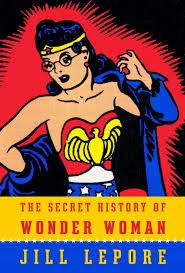
5 x 5 Book Review: The Secret History of Wonder Woman
1. First of all, this book by Jill Lepore is not a secret history of Wonder Woman in the sense that it tells the story of Diana of the Amazons, Wonder Woman, superhero, associate of Superman and Batman, member of the Justice League, &c. This is the secret history of the creation of that character: how the motivations and values and experiences of William Moulton Marston and his associates and his unusual, cobbled-together family all fed into the Wonder Woman mythos. There are call-outs to the comics themselves, of course, and quite a few samples of four-color panels among the illustrations, but the book is more in the nature of an author biography and less an exegesis of an oeuvre; more Will in The World than Asimov's Guide to Shakespeare.
2. And this is not the secret history of Wonder Woman's creator that every comics fan thinks they know. Lepore covers the usual bases: Moulton was a psychologist (well, yes, technically - but with a much more checkered academic profile than we think); Marston was the inventor of the lie detector (well, yeah, kinda - he invented one of them); Marston was a polygamist with two wives (well, yeah, sorta - more accurately, he and his wife shared an additional wife); Marston was into dominance and submission (well, yeah, you could say that - but not in the way that most people imagine). Where the book breaks new and exciting ground is in exploring the heretofore unexamined aspects of Marston's adventures: his identity as an entrepreneur, almost an impressario; his early connections to the suffragist and feminist movements; his close connection to Margaret Sanger, the slightly tarnished saint of the movement that would become Planned Parenthood; and how he used his total control over the creation, writing, and presentation of Wonder Woman to forward his philosophies.
3. In fact, this is not really a comic-book-book. Lepore was apparently not a comics fan, someone seeking to unearth the treasure of her favorite fandom. She is a professor of American History and a cultural historian; she has written on the American experience through the lenses of language, the concepts of life & death, Colonial era war, post-independence race relations, and the writings of Ben Franklin's sister. She brings the same scholarship and seriousness of purpose to her inquiry into Marston. Her non-fan's take on the sections delving into the comic book subculture brings a fascinating perspective and sensibility and only occasionally misses a nuance. This book deserves to be shelved with David McCullough or Doris Kearns Goodwin as much as with Douglas Wolk or Scott McCloud.
4. Speaking of scholarship, the research evident in the book astonishing. The work of a historian - the sifting of documents, the collation of information, the verification of sources - is palpable on every page. This is a virtuoso demonstration, a talented scholar marshaling primary sources to build a coherent picture of obscure events and adding insightful analysis to make meaning. I am tempted to use this as the model text for my research writing class: you can almost inhale the scholarship.
5. Notwithstanding its rigor, the book is a wonderful read. I read mostly non-fiction these days, and much of it can be a slog; this book was quite the opposite. I took it as a vacation book on a trip to California and I could not have been more pleased. Lepore's prose is cogent and springy and occasionally charmingly idiosyncratic. Besides learning a lot, I enjoyed the book immensely. Read it and see for yourself.
The Secret History of Wonder Woman
Jill Lepore
Alfred A. Knopf, New York
Tuesday, January 6, 2015
5 x 5 Bande Dessinée Critique: L'autre laideur, l'autre folie
Different Ugliness, Different Madness by Marc Males
Published byHumanoids/DC Comics, 2005
1. This 5 x 5 review also has a late to the party tag: apparently it was part of a short-lived DC Comics venture into publishing French graphic novels about ten years ago; I found it in the mark-down bins of a comic shop while I was waiting to take Wonder Wife to her birthday dinner last month. I picked up several sale items that evening and this was the best of the lot, by far.
2. This is a comic that has the feel of a French art film: slow-moving, quiet, and living in its details. It tells the story of two lost - or at least displaced - souls encountering one another in rural 1930s America, and its narrative is driven by small steps, tiny gestures, and unhurried interactions as opposed to action and conflict. There is a story arc, and the narrative structure includes flashbacks and flash-forwards, but as a reader I was less interested in rushing the plot forward and more interested in just watching how these people would behave as their circumstances unfolded.
3. But this is not a movie, it is a comic, and it is a wonderfully technique-driven one. You could use Different Ugliness, Different Madness as a course text to accompany Scott McCloud's books: excellent controlled and effective examples of the six forms of transition from Understanding Comics and the five choices from Making Comics seem to jump off the page. Males makes comics the way Hitchcock or DePalma make movies: with a thorough understanding of exactly what strings they are pulling to manifest their vision. And we relish experiencing every manifestation of their craft.
4. One odd note: I don't know if this was part of the original art design or something that happened in the translation process, but the lettering is smaller than it needs to be for the size of the word balloons. The result is a proportionality that reads more like whispering in most mainstream comics, but that is clearly not the intent, for it is used consistently even when it is obvious that voices are louder. It took a while to get used to, but then it just reinforced the feeling of an old movie.
5. The French idea of what a Depression-era American farmer looked like seemed a little off to me, but I am a city boy, so what do I know.
Si vous rencontrez cette bande dessinée, l'acheter!
Vous ne le regretterez pas.
Sunday, December 7, 2014
5 x 5 Graphic "Novel": C.O.W.L.
So, while Wonder Wife was relaxing her birthday afternoon away in a Korean Spa, I had a chance to visit an actual comic book shop and get myself a few presents. This was one.C.O.W.L. Volume 1: Principles of Power.
Kyle Higgins, Alec Siegel, Rob Reis.
Image Comics.
1. I was drawn to this book by its cover - specifically by the union logo it depicted. Here's a closeup:
With this design sensibility and a back-of-the-book blurb that reads Welcome to the Chicago Organized Workers League - the world's first superhero labor union, I was expecting a trade-unionist, maybe even socialist interpretation of the superhero trope. It's not. While C.O.W.L. is indeed a union, and much of the plot circles around contract negotiations, the ambience is much more Mad Men than it is Matewan. The members of C.O.W.L. are certainly not working class, and the personal and political agendas on display have little do with the relationship between capital and labor. That was the first disappointment.
2. The second disappointment was that this is not a graphic novel at all; it is a collection of the first five issues of an ongoing comic. I blame myself for this one - it's clearly stated on the back and I should have noticed - but after have some good experiences recently with true stand-alone GNs, that this one ended in media res was a bit jarring.
3. The story is pretty engaging and the writing is competent, although it sometimes reads like the early days of cable when formerly-banned language was first creeping into broadcasts: just keep dropping those f-bombs so we remember this is "realistic." The art is quite good; Reis reminds me a little of Bill Sienkiewicz.
4. Not for the first time, I thought that a comic was part of the who's-gonna-be-the-next-Walking Dead phenomenon: even in its best bits, I couldn't help but feel that C.O.W.L. was a pitch for a movie or television series. Some of the staging and a lot of dialogue just feels too cinematic and not at all comics-y.
5. I am really tiring of the banality of powers. Superhero teams have become just another collection of stereotypes like any other overworked genre. Instead of the planner, the face, the tough guy, and the gadget man in an A-Team ripoff, we have the flying guy with energy bursts, the guy with the power glove, the girl with telekinesis. There's no wonder, in-story or out, that humans can do these amazing things. Listing the character names with their specialties in the front matter of the book evoked the rules set of a role-playing game more than it did the old school "roll calls" of team comic books.
Wow, that sounded more negative than I expected, but I guess that some good parts aside, I really didn't enjoy the book as whole and won't be looking for Volume 2.
Bonus fun bit: I cannot hear or read the word cowl without thinking of this lettercol title. It debuted in World's Finest in 1964, when I was 6 or 7, and I am pretty sure it was my first understanding of the word's meaning.
I also remember wondering about the title itself, because Batman had a cape, too...
Sunday, September 14, 2014
5x5 Movie Review: X-Men: Days of Future Past
1. There are still over a million hits on Google for "Days of Future Past" when excluding X-Men, Marvel, or Wolverine, and only a few are misspellings of the Moody Blues album title: most use the expression in connection with articles about either about nostalgia or predictions. Was the 1981 comic book story arc the real source of this phrase, and has it really become that ubiquitous just since then? I never actually read the Marvel series, but I knew enough about the story going in that the movie didn't surprise me.
2. The seventies ambience was not quite as wonderful as the sixties ambience on display in First Class, but it may have been even more authentic. And it proved that even Peter Dinklage can't make seventies fashions look good, and that did surprise me.
3. The best thing in the movie was the Xavier-Magneto relationship, both in the past and in the future. Everyone else, even Wolverine and Mystique, seemed to be there just for window dressing, without any internal life at all.
4. I am pretty sure I am done with Wolverine movies, even if he is one of Wonder Wife's favorites to watch; Hugh can hang up the claws any time, as far as I am concerned. Not bloody likely: he's still in like every third Marvel comic, isn't he?
5. I am also getting close to being over superhero movies in general. After so long wishing somebody could do one right, it now almost seems that there are too many being done all the time. Maybe I am just waiting for someone to do one really well.
And was I the only one who thought Quicksilver was too fast?
Subscribe to:
Posts (Atom)