Showing posts with label books. Show all posts

Monday, August 19, 2019

Radical

So, Wonder Wife is off to Hawai'i and I have plenty of time on my hands, and over this weekend I read Cory Doctorow's Radicalized.

The book is collection of four long short stories/short novellas/whatever-they-ares. Because some of the motifs and conceits are sort of science-fiction-y and because there are (thinly disguised) superheroes in one story, I am talking about it here on Thark, but the subtitle of the work is Four Tales of our Present Moment and I could easily place this on Epicurus (where I get as political as I ever do).

From the internet of things shit to institutionalized racism, from the inhumanity of healthcare-for-profit to the inevitable failure of libertarian me-firstism, Doctorow throws all that is wrong with our culture into stark relief through compelling narrative: political analysis delivered through ripping yarns.

I'm not sure what impressed me more: Doctorow's grasp of the ethical aspects of technological, economic, and political structures and his lucid unpacking of them, or his ability to tell an engaging story through spare, direct prose that still sings with a distinctive voice. I don't have to choose; it's a win-win.

I was familiar with Doctorow from Boing-Boing and Twitter - along with Sarah Kenzidor, he is one of my go-to sources in these troubled times -  but I hadn't actually read any of his fiction until now. I am remedying that immediately: Walkaway is open on the table now.

Read Doctorow.

Wednesday, April 3, 2019

The sensibilities that time forgot


So, I made a shopping blitz through Henderson Books the other week and grabbed a whole slug of stuff, including a copy of The Land That Time Forgot by Edgar Rice Burroughs. The paperback I bought was not graced with the old style cover art picture above; it was released to coincide with the film version of the story ("A major new motion picture!") in 1974. I have always had a soft spot for that cheesy, breezy Doug McClure flick, and thought I would check out the original, as it was a Burroughs I had never read in my glory days of cutting a reading swath through all things pulpish.

A bit of a shock it was.

The novel was originally published in 1918 and man, does it show. The typical ERB-ian adventure is there, all right; lots of excitement and derring-do to go around from a stalwart protagonist. But the casual racism and sexism, the unapologetic imperialist and colonialist attitudes, and a surprisingly robust anti-socialist/communist stance were real stumbling blocks to my enjoyment. There's lots of discussion about not judging something out of its own context, and I get that, sort of. But as many people have noted about Golden Age comics, sometimes it is just hard to read them. In point of fact, I didn't finish the book.

This response I had made me wonder about all the other ERB I had read as young man - Tarzan, of course, and the Barsoom novels, Pellucidar, and Carson of Venus. Are they as dated and problematic as this is? It was 45 years ago or more that I was reading them. Were the times so different then - was I so different then - that they were, and I just didn't notice?

I'm not sure I really want to find out; perhaps imperfect memory is a gift in this case.

But I do wonder about the "product of its time" argument. I am currently reading some of G.K. Chesterton's Father Brown mysteries (two books from the same Henderson haul - one upstairs in living room and one downstairs on my nightstand). These were written in the early 1920s, and while some of the language and terminology may be a bit awkward, to say the least, there's a lot less stereotyping and bit more humanism present. Maybe that can straightforwardly be chalked up to a difference between Burroughs and Chesterton, but it takes some of the responsibility for the, ah, challenging characteristics of art away from "its time" and lays it at the feet of its author.

In any case, I am a little trepidatious about dipping back into another fave from my youth, Ernest Gann, but I'll give it a go. Twilight for the Gods was written in '56, so how bad can it be?


Monday, July 16, 2018

25 words or less: Jinkies!


Meddling Kids by Edgar Cantero; Doubleday, 2017

An older Scooby gang – respectively fugitive, alcoholic, crazy, and dead - revisit their last case as teenagers, encounter the Necronomicon, confront Lovecraftian horrors. Read it.

Sunday, August 30, 2015

Make a short story short

Here's another not-review of a book in the Summer Reading Program: under consideration is New Frontiers, a collection of stories by long-time, award-winning SF writer Ben Bova.

A golf tournament on the moon. An asteroid miner whose ship is under attack from pirates.  Cryogenically frozen billionaires. A road race on the moon. Virtual reality duels. Astronauts trapped on Mars. The aging leader of an interstellar empire considering the fate of Earth. It's like 1972 all over again - this one has enough nostalgie de la boue to fill a lunar landing module.
 
Maybe that's a little too much: some of the stories don't just echo with familiarity, but actually creak a little bit, as well. I mean, two guys fighting over which of them gets to take a woman to Aspen for the weekend? Women lawyers trying to desegregate the men-only bar at a private club? Isn't this stuff a little dated?

This summer's reading has comprised a lot of revisiting of old favorites and favorite styles in my favorite genres - as opposed to last summer, during which the reading list included almost exclusively non-fiction. There's a lot of fun to be had there - I don't need all or even most of my fiction to be "literary" - but I guess I don't want to just re-hash the past, either. Those were good times, but that was then and this is now. As much as we cherish what was good about the old stuff, we need to keep moving with times and freshen up the act.

(In a similar vein, I just read an excerpt from a Seven Soldiers of Victory comic published in 1941. As much as I would like to see more of that straightforward storytelling and art today, I certainly wouldn't want to reproduce its casual racism.)

In any case, this is a decent collection of short stories (with the emphasis on short) that come closer to what I used to read in high school than anything else I have encountered. Take that as an endorsement or warning or both.

Tuesday, August 25, 2015

5 x 5 Book Review: The Rhesus Chart by Charles Stross

1. Another Summer Reading book, this one the fifth in the Laundry Files series by Charles Stross.  (This appears to be my summer for coming in late on book series.) The Rhesus Chart is the latest entry in the continuing escapades of The Laundry, the British intelligence agency chartered to combat supernatural threats in a particularly Lovecraftian world. You might think X-Files or Torchwood but not really close: this group fights elders gods and eldritch horrors that make most demons look like chumps. Even vampires (the antagonists of this book) are in the minor leagues in this world.


2. Stross has a great conceit for incorporating monsters and magic into the modern world: complex operations of higher math serve as spells or rituals for opening gateways to other, nastier dimensions. Just thinking hard about certain calculations or formulas can lead to Bad Things happening - and with computers increasing our capability for calculation, more Bad Things are happening more often. The Laundry are just the folks who can control the Bad Things better; the agents are mostly wizards of some kind or another. There's a character call the Eater of Souls - and he's one of the good guys.

3. After mashing up arcana and espionage, Stross spreads a layer of satire over the whole thing. The Laundry is an organization subject to committee meetings, expense vouchers, strategic plans, health & safety regulations and all the rest: bureaucracy at its most relentless. Our protagonist, Bob Howard, is subject to "matrix management" and has to divide his time between his work as an IT professional and as a field agent. In many ways, this is the most enjoyable aspect of the book, but it takes an awful lot of suspension of disbelief to think that the organization wouldn't be run along more military lines, given the nature and scale of the threats they face.

4. That bureaucratic milieu does give the book a feeling more like LeCarre or Deighton than Fleming - this book could have been called Tinker, Tailor, Soldier, Sorcerer for all the double-talking, double-dealing, and duplicity within the agency.

5. Overall, the biggest issue I have with book is not the setting or the characters or even the plot, which was a little plug-and-chug but all right in the end. It's that Stross just doesn't write with enough economy. Howard is very self-conscious narrator and Stross uses devices such as footnotes, digressions, and deliberate awareness of the story as a story, and these are tools that need finesse. A Pratchett or an Adams can handle them just fine; Stross often comes across as just too pleonastic and tedious. Still and all, it's not a bad diversion, if you like spies, horror, and bureaucracy and and can wade through fifty or sixty more pages than you need to.

Friday, August 21, 2015

5 x 5 Book Review: Fuzzy Nation by John Scalzi

1. So, once more the Summer Reading Program is featured on Thark. This work is John Scalzi's "reboot" of Little Fuzzy, H. Beam Piper's celebrated 1962 novel, which is now in the public domain. As might be inferred from my previous discussion of the beloved Bay Ridge library, I read the original work as a young man and have a dim memory of it. I recall that it was pretty good, but I daresay Fuzzy Nation is better.

2. In his author's note, Scalzi compares his re-imagining of the story to the recent Star Trek film reboot, and jokes that it should have better science. And he's right - the science part of this science-fiction story hits just the right notes. The technology pertinent to the story appears reasonable, plausible, and consistent, and to the extent that technological details matter to the plot, Scalzi always plays fair - there are no convenient rabbits out of hats. The bigger issues - interplanetary travel, for example - are hand-waved in a businesslike manner and don't distract from the main human story.

3. I'd put Scalzi up there with Arthur C. Clarke for his presentation of humans in space acting like real humans: they all have jobs with organizations or corporations, and work with bosses and colleagues, and deal with rules and regulations. They even pay bills. Scalzi creates a realistic versions of the bureaucratic infrastructure, political and commercial, that would both result from and be necessary for humanity's off-planet expansion.

4. Scalzi does a great job with the individual characters as well, in particular with the protagonist Jack Halloway. He keeps the reader guessing until the very end just exactly what kind of man he is and what his motivations are, while making him engaging and identifiable.

5. The oddest bit about this book is that in the end, it is really a legal thriller, like something that John Grisham might write if he tried his hand at SF. The protagonist is a disbarred lawyer and legal niceties play an integral role in the plot - the first precedent-setting court case is cited on page 23, and it's not the last. Climactic scenes take place in front of a judge. It's a fascinating bit of genre-blending, and not something I remember from the original. But perhaps I should go back and check.

Wednesday, August 19, 2015

Just like old times

So, although this post is part of the Summer Reading Program, it is less a book review than a rumination, because reading Old Venus was less a literary experience than an evocation of times gone by.

Concept anthologies are pretty common in science fiction - those collections of stories written to meet particular specifications in theme or conceit. Carmen Miranda's Ghost Is Haunting Space Station 3 is one such collection - every story had to include that titular sentence. In the case of Old Venus, the unifying concept is a bit broader: authors were asked to write stories set on the Venus we "knew" before Mariner 2 took all the fun out of it: that perpetually cloudy, perpetually rainy, many-oceaned, deeply-swamped planet of mystery. that we know now was never more than a fiction. And the anthology delivers, in spades.


I think I know whereof I speak. When I was a kid, I basically read out the sci-fi section of the Bay Ridge branch of the Brooklyn Public Library, a collection comprising mostly material from before the New Wave era, Golden Age greats and material from that period one critic calls the Radium Age. I read Carson of Venus by Edgar Rice Burroughs and "The Long Rain" by Ray Bradbury and everything else between and around them. Venus was a popular spot for science fiction. Sword & planet stories as they call them now, or space operas, or speculative fiction, or hard SF - all varieties of narrative could be told there.

And the there was key: Venus was not just another generic backdrop. There was something about the relentless, remorseless dreariness of the planet that added a dimension to whatever story was being spun. In the best tales, Venus itself became another character in the narrative. And in this new collection of Old Venus, most of the stories more than meet that bar.

There is a great variety in the presentation -  a former Buffalo Soldier surviving the Titanic sinking only to be swept into a conflict between blue people and birdmen, hard-bitten mercenaries versus forgotten Venusian gods, scientists and poachers and adventuresses exploring the planet, Russian communists and Nazis, and even a Bertie and Jeeves pastiche. In only a couple of cases did I feel the author just took an already-begun story and set it on Venus to meet the criterion; in just about all of the contributions, the Venus we wished we'd known is evoked in glorious damp detail and becomes an integral part of the story.

Just like the old days.

Whether you're a long-time reader of SF who wants to revisit the wonder, or a newer reader who wants to know what it was like Back in the Day, this is the collection for you. Apparently there's an Old Mars, as well; I need to seek that one out.

Last note: This is listed as "edited by" George R.R. Martin as well as Gardner Dozois. Dozois wrote the introduction and, as near as I can tell, the biographical notes; I have no idea what Martin did besides get his name on the cover to sell copies.

Tuesday, August 4, 2015

5 x 5 Book Review: Raising Steam by Terry Pratchett

1. So, once again this is part of the Summer Reading Program but is showing up here on Thark instead of Epicurus because, well, this is where it belongs (as I sort of made clear here.) Raising Steam is the last Discworld book published before author Terry Pratchett's death earlier this year; one more volume is due out later this month, but that will apparently be the end of the series, at least for contributions from its originator. The world that Pratchett created is so rich and detailed that I would be surprised if there weren't more books to come from other authors, perhaps even in some sort of shared-world deal.


2. The idea of other authors writing Pratchett's characters came up for me when I was reading Raising Steam, because honestly, it didn't have the same crackle and spark usually marks Pratchett's writing. His struggle with early-onset Alzheimer's was widely publicized, and it is sad to think that his last works might have been marred by the effects of the disease, or by Pratchett's need for collaboration from lesser lights. I guess we'll never know for sure under what conditions the book was written, and I'll definitely be curious about The Shepherd's Crown, the posthumous novel.

3. Much of the flatness of the story lies in the narrative. While the stakes are enormous - the plot centers on a coup within the dwarf nation by fundamentalist terrorists, a not-very-subtle allegory - the protagonists never seem to be at very much risk or to suffer any serious setback. In fact, in neither the political situation nor the technological challenge of bringing steam locomotion to Discworld does   failure ever seem to be a threat at all: terrorists, physical adversities, and railway accidents are all dealt with summarily and successfully, and the body count (except for Bad Guys) is really quite low, all things considered.

4. I think that Pratchett also fell victim to something I saw in the later films of Christopher Guest. I felt Guest started to like his characters too much: Waiting for Guffman, Best in Show, and A Mighty Wind are progressively less edgy and dark (although For Your Consideration get a lot of that juice back). Similarly, I think Pratchett grew a little too fond of Vetinari, Vimes, Moist, and the others; they shine a little too brightly and achieve a little too easily, their flaws plastered over. I liked the the Moist who was always a step away from cutting and running; he was someone not to be entirely trusted instead of a happily married hero, and that made him more interesting.

5. All that said, there is enough good stuff in the book to make it worth the read - and I still did laugh out loud while reading it. Reading even a lesser effort from Sir Terry is excellent way to pass the time.

Friday, July 17, 2015

5 x 5 Book Review: The Martian by Andy Weir

1. Even though this is part of the Summer Reading Program, I figured it belonged here on He is a Thark because it's technically science fiction. I say technically because I guess it's since in the future and since the ion thruster drive that the Hermes spacecraft uses appears to be more advanced than actual models in service, it gets shoved into that category. But the science in this fiction is so hard that it's practically adamantine: it's really just science-filled-fiction. Delicious crunchy fiction with a thick, chewy science center.


2.  Randall Munroe hit the nail on the head with this summary of the story, but what that leaves out is how downright funny the book is - or rather how funny the main character Mark Watley is, since most of the book is in his voice. The narrative establishes that Watley's coping mechanism is humor, and being stranded on Mars gives him a lot to cope with, so that humor comes through strong, leavening both the tech-talk and the life-and-death drama.

3. Because the movie trailer came out and got so much play just before I started the book, I could only hear Watley in Matt Damon's voice. That's not so bad, really.

4. Writing that contains a lot of detail and concrete description and writing that appears to be demonstrating how and how well the prose could be turned into a film: am I making a distinction without real difference? Some of the scenes - Earthbound episodes, primarily - read a lot like a novelization of a movie - you can almost see the blocking and the cuts. Scenes in offices are written even more visually than descriptions of Watley's activities on Mars. Some of that results from the change of narrative voice (from Watley's diaries to third-person narration) but some of it seems a little calculated.

5. Overall this was a very satisfying read, and only because under the tech-love, the melodrama, and the funny, Weir occasionally gets to a kernel of very real human emotion and experience, and the reader forgets that it is a book or a wannabe movie and gets lost in the people.

Sunday, June 28, 2015

40, 41, maybe...

So,  in my pursuit of summer reading, I picked up And Another Thing, the post-mortem continuation of Douglas Adams's great Hitchhikers Guide to the Galaxy series by one Eoin Colfer. The book isn't going to get the 5x5 review treatment because I doubt that I will finish it. (I am off on a five-day work trip right now and I didn't even bother to bring it.)

I am a big fan of Adams's writing. It was not just in Hitchhiker's Guide and the Dirk Gently stories that his drollery and wit shone, but even in his more peripheral work, such as the video games he wrote way back when and his non-fiction book about endangered species, Last Chance to See. He had a voice as distinctive as that of P.G. Wodehouse; Colfer had quite a task before him, following Adams and using his same characters and milieu.

It turned out to be an impossible charge to fill. All the moves are there, but none of the magic shines through. I imagine it was like this when Bud Abbott teamed with Candy Candido late in his career: while they got some decent reviews, it's hard to imagine Who's On First? being done by anyone other than Abbott & Costello. Not to say that Colfer doesn't give it a good try; I am not familiar with his other work, but he clearly has made a yeoman's effort to recreate Adams's deft touch. His faux-Adams is not nearly as bad as David Soul playing Rick Blaine in the TV series based on Casablanca or Josh Mostel's valiant effort as Blotto Blutarsky in Delta House. It's more like you tuned in to see Larry, Moe, and Curly and got Larry, Moe and Joe DeRita: close, but no cigar.

It's not like this this sort of thing can't be done: Spider Robinson did a creditable job of channeling Robert Heinlein on Variable Star, for example. It's just that Colfer didn't do it here. No shame in the effort, but not enough results to get me to finish.

Tuesday, March 17, 2015

5 x 5 Book Review: Of Dice and Men


Of Dice and Men
by David M. Ewalt
Simon and Schuster, 2013


Thanks, Gracie, for lending it to me!


1. The promotional catchphrase for this book is "The Lord of the Rings meets Moneyball." I'm not that's the best description* of this memoir cum business history, a cocktail that is two parts nerd apologia for the general public and three parts analysis of the game, product, and scene that is Dungeons & Dragons, topped with a splash of insider reference for hard-core gamers. I think in the end, no audience will be totally satisfied: not regular folks looking to understand the nature of geekdom, not business students wishing to understand a commercial phenomenon, and not game geeks looking for new scriptures. But everyone will take something away.

2.  The"autonerdography" bits work well enough in the beginning of the book, as Ewalt establishes himself as a functioning geek: a professional with adult relationships and an ostensibly normal and fulfilled life, but who hasn't let go of some of his early influences and interests - in this case, D&D.  There's perhaps a little too much cuteness in the comparisons between a gaming habit and drug addiction and too little self-awareness of how much his position as a journalist allows him to indulge his avocation in ways not available to most adult geeks, but it's an engaging enough portrayal nevertheless.  One writing choice damages that connection for me late in the game. Ewalt establishes a convention early on of switching to italics when he is describing the scenes and characters in the games he is playing, rather than the real people he meets. Toward the end of the book, however, he starts to relate his inner reflections on the outer world the same way. This conflation of the "fantasy" representations with those of his allegorical awakening to the True Meaning of D&D seemed a little too precious, as if he were trying to elevate his story a little higher than it deserved.

3. The business history seems oddly skewed. It takes 180 pages to go from The Fantasy Game in 1972, perhaps the earliest direct ancestor of D&D, through The Blue Box and The White Box and The Red Box and Advanced D&D and all the other editions and get to Version 3.5 of the modern game in 2003. Then Ewalt skips to D&D Fourth Edition, released in 2008, in literally the next paragraph. D&D 3.5 was a major phase in the evolution of the game - and is still a force to be reckoned with, especially if you include the Pathfinder series by open-license publisher Paizo (often referred to as D&D 3.75), which isn't mentioned at all. The book takes a detour after D&D 4e into LARPing (live-action role-playing, which isn't really D&D at all) before returning to the Fifth edition of D&D. This omission smacks of something besides objectivity.

4. For all that Ewalt misses, he connects best on one element aimed directly at hardcore gamers. As part of his pilgrimage to Lake Geneva, Wisconsin, the birthplace of D&D, he plays in a session and later has dinner with Frank Mentzer, a close friend of Gary Gygax, the "creator" of D&D and author of many of its key editions. Ewalt is on the verge of moving from lifelong player to a fledgling Dungeon master - the one who has to run the games - and gets this advice from Mentzer:
The ideal game is a player-driven game. They are not actors in a play you wrote. You are presenting a setting, you are doing the stage dressing and letting them come up with the play. And when they come up with a plot twist, you should be able to go that way full force, because that is what they want to do. Some of the worst games are when somebody has a great, grand, and glorious vision, and they want victims to walk out and play their roles with no input in what happens.
That alone was worth wading through the sometimes shallow waters of the book.

5. The cover image shows a twelve-sided die with the book's title on the face where the "1" - an automatic failure - would be. Why Ewalt, who several times mentions in the book how much small details matter to geeks, would use a graphic that showed both the least-used die in the game and the least desired outcome is a mystery to me.


*But then I have a bad history with literary marketing catchphrases.

Friday, January 16, 2015

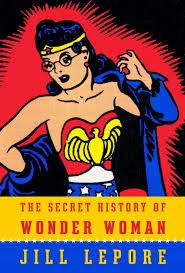
5 x 5 Book Review: The Secret History of Wonder Woman


1. First of all, this book by Jill Lepore is not a secret history of Wonder Woman in the sense that it tells the story of Diana of the Amazons, Wonder Woman, superhero, associate of Superman and Batman, member of the Justice League, &c. This is  the secret history of the creation of that character: how the motivations and values and experiences of William Moulton Marston and his associates and his unusual, cobbled-together family all fed into the Wonder Woman mythos. There are call-outs to the comics themselves, of course, and quite a few samples of four-color panels among the illustrations, but the book is more in the nature of an author biography and less an exegesis of an oeuvre; more Will in The World than Asimov's Guide to Shakespeare.

2. And this is not the secret history of Wonder Woman's creator that every comics fan thinks they know. Lepore covers the usual bases: Moulton was a psychologist (well, yes, technically - but with a much more checkered academic profile than we think); Marston was the inventor of the lie detector (well, yeah, kinda - he invented one of them); Marston was a polygamist with two wives (well, yeah, sorta - more accurately, he and his wife shared an additional wife); Marston was into dominance and submission (well, yeah, you could say that - but not in the way that most people imagine). Where the book breaks new and exciting ground is in exploring the heretofore unexamined aspects of Marston's adventures: his identity as an entrepreneur, almost an impressario; his early connections to the suffragist and feminist movements; his close connection to Margaret Sanger, the slightly tarnished saint of the movement that would become Planned Parenthood; and how he used his total control over the creation, writing, and presentation of Wonder Woman to forward his philosophies.

3. In fact, this is not really a comic-book-book. Lepore was apparently not a comics fan, someone seeking to unearth the treasure of her favorite fandom. She is a professor of American History and a cultural historian; she has written on the American experience through the lenses of language, the concepts of life & death, Colonial era war, post-independence race relations, and the writings of Ben Franklin's sister. She brings the same scholarship and seriousness of purpose to her inquiry into Marston. Her non-fan's take on the sections delving into the comic book subculture brings a fascinating perspective and sensibility and only occasionally misses a nuance. This book deserves to be shelved with David McCullough or Doris Kearns Goodwin as much as with Douglas Wolk or Scott McCloud.

4. Speaking of scholarship, the research evident in the book astonishing. The work of a historian - the sifting of documents, the collation of information, the verification of sources - is palpable on every page. This is a virtuoso demonstration, a talented scholar marshaling primary sources to build a coherent picture of obscure events and adding insightful analysis to make meaning. I am tempted to use this as the model text for my research writing class: you can almost inhale the scholarship.

5. Notwithstanding its rigor, the book is a wonderful read. I read mostly non-fiction these days, and much of it can be a slog; this book was quite the opposite. I took it as a vacation book on a trip to California and I could not have been more pleased. Lepore's prose is cogent and springy and occasionally charmingly idiosyncratic. Besides learning a lot, I enjoyed the book immensely. Read it and see for yourself.


The Secret History of Wonder Woman
Jill Lepore
Alfred A. Knopf, New York

Tuesday, August 19, 2014

Really magical

So, I just finished reading Terry Pratchett's Making Money, the further adventures of Moist von Lipwig, Ankh-Morpork's erstwhile Postmaster, as he becomes Director of the Mint. I was going to write a review, but it just boils down to this: it's a Discworld book, go read it.


However, after I read the book, I went to look up any current information on Pratchett, who in 2007 announced that he had been diagnosed with early-onset Altzheimer's. His disease is progressing, of course, but he has remained active up until quite recently. As I was reading, I stumbled across a quote from Pratchett in which he says the label magical realism is "a polite way of saying you write fantasy and is more acceptable to certain people."

Never having met a taxonomy I didn't like, I played with this idea for a bit.

Our friend the Wikipedia provides this: Magic realism or magical realism is a genre where magic elements are a natural part in an otherwise mundane, realistic environment.

A source at Princeton says Magic realism or magical realism is an aesthetic style or genre of fiction in which magical elements are blended into a realistic atmosphere in order to access a deeper understanding of reality. These magical elements are explained like normal occurrences that are presented in a straightforward manner which allows the "real" and the "fantastic" to be accepted in the same stream of thought.

Emory University describes magical realism thus: A literary mode rather than a distinguishable genre, magical realism is characterized by two conflicting perspectives, one based on a so-called rational view of reality and the other on the acceptance of the supernatural as prosaic reality. Magical realism differs from pure fantasy primarily because it is set in a normal, modern world with authentic descriptions of humans and society.

My literary colleague, Super Sissy, agreed in principle, although she approached it by saying that fantasy stories were set in created worlds and magical realism was set in this world. This is one way to interpret "mundane, realistic" and "normal, modern," I suppose.

The upshot of all of it is that magical realism is somehow literature while fantasy is just plain fiction, and Pratchett writes fiction.

The funny thing is, Pratchett's stories may be set in an imaginary, faux-medieval world, but it is a mundane, realistic, normal and deceptively modern one; the quotidian and the banal walk side by side with the supernatural. The Discworld stories usually do provide tweaked but authentic descriptions of humans and society and often access a deeper understanding of reality or at least punctuate the hidden meaning of mundane realities.

But Pratchett doesn't get to be in the magic realism club with Borges and Marquez because he made up Ankh-Morpork and didn't set his stories in Columbus, Ohio.

On the other hand, Ron Goulart's Please Stand By, a short story about an ad man who turns into a small grey elephant on national holidays, is certainly based on the acceptance of the supernatural as prosaic reality, but I don't think anyone would call it magical realism. (It is a pretty funny story, though.)

I guess it matters little. Most lists of fantasy sub-genres include Magical Realism as a divison on the same tier as High Fantasy, Sword & Sorcery, Ghost Story, and Weird Western, so maybe it's not so high and mighty a literary mode as all that. It just seems that some labeling seeks to impart status rather than to describe characteristics. I recall all the times that Vonnegut and Bradbury were declared by the literati to be writing fiction instead of science-fiction, because their stuff was good, so obviously it couldn't be sci-fi. (Even Bradbury was subject to this ideological hegemony at the end and railed against being called a sci-fi writer.)

Whatever. Read good books, however they are categorized, and Making Money is one of them.

I'll put revising the genre taxonomy on my do-list and let you know when I'm finished.


Tuesday, August 5, 2014

Book review: Just the counterfactual, ma'am

So, I suppose I should read blurbs more carefully.

I was excited to get to Archduke Franz Ferdinand Lives! by Richard Ned Lebow on my WARMER reading list. By the style of the title, I imagined it was a collection of short stories in the alternate history genre, all playing off the same PoD (point-of-divergence from our timeline into the counterfactual): that the titular heir to the Austro-Hungarian throne was not killed in Sarajevo, thereby altering or preventing completely the First World War. Alas, my perception or my memory had failed me: this was not the case.


The book does concern alternate history based the PoD as described, but it is neither a collection of short stories nor a poorly-titled novel. The author, Richard Lebow, holds a professorship at King's College London and emeritus professor status at Dartmouth among many other scholarly distinctions. Academia must be in his blood (his author bio claims "over 200 peer-reviewed articles") because Lebow doesn't write an alternate history as much as he discusses alternate history.

The first chapter in the book defines the whole realm of counterfactuals for us, and Lebow seems to be trying to legitimatize the genre by showing how the consideration of imagined worlds and their progress, however unverifiable, gives us lessons to apply to understanding the real world. He then goes on for a whole chapter justifying why and how he thinks that Ferdinand's survival would have prevented WW1. (Lebow is a political scientist and his extrapolations of power and policy are persuasive.) He then goes on to outline the best of all plausible outcomes and the worst of all plausible outcomes. Finally, he tells us everything again, in a summary chapter that once again chases those lessons we are supposed to have learned.

In some ways, this is a very valuable resource on how to develop a plausible counterfactual. I have tried to create a broad-strokes alternate America for a role-playing game, and I am sure Lebow would laugh at my shoehorned contrivances and lack of understanding of how the events I changed had actually come to occur. I am sure my world is not terribly plausible.

But plausibility is just one element of good alternate history, and in the end, it's not even the most important one. The best alternate histories are engaging, exciting, surprising - and fun. It is in the juxtapositions of real historical figures with imagined ones that we find that sweetness and strangeness which capture our attention. Credible historical extrapolation is fine, but just like not letting facts get in the way of a good story, totally reasonable counterfactuality should not get in the way of a good alternate history. Lebow seems to overlook this consideration totally.

Lebow does tell some brief stories in his descriptions of his alternate worlds. My favorite involves Governor Barack Obama of Hawaii facing down the federal government in the 2010s over the planned internment of Japanese-Americans. (Without world wars, international and racial tensions simmered longer). This great plot is raised and disposed of in three pages; Lebow is much more interested in examining causes and consequences than he is in creating narrative and character.

I think I'd love to take a class from Lebow: a graduate seminar in counter-factual political science or something. But he should perhaps stick to the academic journals; this book is too dry for popular consumption, even as background reading. I will take comfort in believing that somewhere there is an alternate world, exactly like ours, except that someone wrote a great novel about Archduke Franz Ferdinand surviving his assassination attempt...

Bonus editing tidbit:

That section concerning Obama includes this passage (emphasis added):
Obama [...] calls upon the administration to make public any evidence it has of a security threat posed by Japanese residents or Japanese Americans. The attorney general refuses to do this on the grounds of national security and does not respond to Obama's request that he be briefed on camera.
Now, it is clear to me that the line was supposed to end in camera - in secret or confidentially. That an editor at Palgrave McMillan could make this kind of error - not to mention the several other proofreading mistakes I found - is more than a little disheartening.

Thursday, June 26, 2014

5x5 Book Review: Who Can Save us Now?

Who Can Save Us Now?: Brand-New Superheroes and Their Amazing (Short) Stories by Owen King (Editor), John McNally (Editor), Chris Burnham (Illustrator)


1. The behind-the-colon portion of the title of this book is misleading. Each of the stories in this collections features someone who has super-powers or who is exceptional in some way; very few of them contain stories about anyone who is a hero, either nominally or by their actions. 

2. These stories are what I would call literary fiction: in a nutshell, they are introspective, character-driven, slow-moving, and often a bit lyrical. Most of the stories do not generally aspire to reflect on or investigate the nature of heroism at all, much less superheroics; in the few cases when the attempt is made, is just seems like a prose version of something like the Avengers Initiative. The books feels less like an attempt to expand or experiment with genre boundaries than it does like slumming; Paul Chadwicks' Concrete did a better job than this collection of playing with the "reality" of superheroes.

3. I know that as literary fiction, these stories need to be Serious, but do they always have to be so depressing, too? The characters are, by and large, morally bankrupt, sexually impotent, and ethically challenged, and make bad choices, form dysfunctional relationships, and engage in destructive behavior. Only four of the 22 stories end on any kind of hopeful note, and only one is even mildly heroic. If a story makes me feel like I need a Zoloft, does that mean it was good?

4. The stories are illustrated, not with sequential art, but rather just with title page drawings. The artist, Chris Burnham, has done comic book work (he seems to sit at the same stylistic table with Frank Quitely) but his work here seems sketchy and almost anti-comicky, as if the editors really didn't want this book mistaken for a graphic novel. Because then it wouldn't be Serious.

5. I am sure that the editors and many of the authors have more than a passing acquaintance with superhero comics, at least based on the biographical notes and a few of the reference made in the stories. But all of them seemed to be running away from the superhero genre, its conventions and tropes, its potential and its flaws, even its art style. Maybe I'm being too harsh, but rather than asking "What would it really be like for a superhero-person if they were damaged emotionally?" these stories seem to say "Hey, let's put a mask on Holden Caulfield!"

Since this book came out in 2008, this should have a Late to the Party label as well...

Thursday, August 15, 2013

Size matters

So, I was walking through my bedroom slash office getting something, and my eye happened upon some books, and I saw what I thought was an interesting juxtaposition. As usual, I over-thought it, and gathered more samples, and anyway, herewith are the results:

The two tallest books in my bookcases:


The two thickest books in my bookcases:


The two smallest books (by surface area of cover) in my bookcases:


I'm not sure what meaning I can glean, but there it is.