Showing posts with label sci-fi. Show all posts

Friday, July 31, 2020

Hero project part 7; the Ur-characters

See:  The pilotPart OnePart TwoPart ThreePart FourPart Five. Part Six.

So this has been a romp through a pretty clearly-established but totally in-my-head comics universe. (Actually, it's multiverse, with at least two other Earths, one an alternate-history scenario and the other a near-future setting, but maybe that's another series.) The Bravos have pretty much solidified now, but their roots go way back into some of my earliest work. Here are artifacts from some far antecedents of the current characters.

First, piece so old there was actual typing on the sheet from my Smith Corona portable manual typewriter (I cropped it out).These are all folks that were originally slated to appear in prose, rather than in an imaginary comic.


I rather like the concept of Ebon and don't know why I left it. He's Pyewacket, the cat familiar from Bell, Book, and Candle, transformed into a human.

Domesday is a proto-Moxie, with a little too much Dark Phoenix, I think.

You can see Virago in Athena quite clearly. The character concept didn't change much but she sure went through a lot of names over the years.

Yancy was the size changer, courtesy of an alien police officer's uniform - maybe some Greatest American Hero going on there?

I made a superhero version of the Warner Brothers character Tasmanian Devil well before DC did. According to my notes, he was an ex-soldier with PTSD before the term was in use.

The final piece in this series is an illustration of the characters in a projected 21-chapter science-fiction novel that took them across the galaxy- that's the flow chart and table of contents there on the left. I think about two chapters were even written,a little more if you count my writing the opening scene about six times. I think the world-building and the character creation were enough to satisfy whatever itch I was scratching; the same with all the little doodles and scribbles of characters over the years. Even now I can conjure up entire scenes, as if I had read the books or seen the movies. Anyway, here they are:


Walking in with raincoat and gat is the main protagonist of the novel, Earthling. I can tell you exactly where his name came from: in a letter column to some DC comic, a reader complained of the use of the term "earthling" in a story involving aliens, saying "You can't imagine how old-fashioned that sounds". The editor responded: "You're right. I can't." Earthling was a person from Earth who had somehow gotten to be a part of the teeming intergalactic community well before anyone from Earth should have, so his name just identified his planet of origin. I believe his weapon is a one of the last remaining star-guns and draws energy from dark matter or something. He's the one who draws the rest of the characters into the story, and collectively they are called The Terran Irregulars. (I think that was going to be the title, too.)

The winged woman is Earthling's alien companion Ariel. Her schtick was that she could not be lied to. Originally, her name was Windy, and if you are thinking of a 1967 hit single by The Association, you'd be right.

I think the fellow swinging in on the rope is the Ebon, just going by straight-up Pyewacket here. He's giving a ride to the Tasmanian Devil.

The woman swinging in is Debbie - with the epithet "the girl with the doomsday mind". Domesday going by her real name, I guess.

Drop-kicking the drone is, of course, Athena.

And rounding out the group is a multi-limbed fellow that the the team must pick up along the way, since he's not listed among them in the novel outline:  Yantzee - the alien whose hobby was Earth. I supposes it's fitting that this shaggy dog epic ends with a character who so closely resembles a Thark.

If you have hung in here until now, thanks for coming along for the ride. It was fun to explore all this character creation, and re-examine how character concepts evolved and changed. Who knows - maybe we'll even do something with these some day. 

Saturday, April 13, 2019

In the green (streaming serendipity part two)

So, as I mentioned last time, Wonder Wife and I had a short run of streaming some good movies lately. As I was napping watching The Monster That Challenged the World ( a quintessential 1950s monster movie, about which perhaps more later) I recalled that I needed to post about the second great find.


Prospect is a great hard science fiction story, one that could have come from Clarke or Asimov. It is both big and small in perfect proportion. It is big, because it gives us a constant and full sense of a much wider world than we seen in the film itself, without having to show us any of it. It is small because it is totally focused on the characters and their struggles, not special effects or spectacle. There is conflict and danger in abundance, because these particular people are in this particular place facing this particular problem. They are not trying to save the world, but rather just trying to survive.

They are Cee, a young girl stranded by circumstance on a hostile moon during a treasure-hunting expedition, and Ezra, a freebooter of dubious ethics, who is an enemy-turned-ally. Together, these two must face natural and human threats in order to secure passage back home - or at least off the planetoid full of threats.
 

The actors are wonderful. Young Sophie Thatcher gives a compelling, tightly-controlled performance as Cee - it's all in the eyes - while Pablo Pascal's turn as the expansive Ezra is captivating, seemingly an admixture of equal parts True Grit, Firefly, and Shakespeare.


As equally compelling as the leads is the art design. The vehicles and suits and equipment - excuse me, the sets and costumes and props - are all totally realistic and plausible in a retro-futuristic dieselpunk sort of way. Everything looks and feels utilitarian and grimy and used; I haven't had so strong a sense of realness to a science fiction setting since the first Alien.


If you want edge-of-your seat tension in a completely engaging sci-fi world,  Prospect will not let you down.

Sunday, March 5, 2017

Science Fiction by Gaslight: Episode 4

Title: "The Tilting Island"
Author: Thomas J. Vivian and  Grena J. Bennett
Published in: Everybody's Magazine September 1909

Category: Catastrophes

Summary: A reporter and a professor traverse Manhattan during the island's destruction by a massive earthquake event.

Unlikely coincidence: A Geology professor who has made a fifteen-year study of Manhattan and the fault lines under it being on a streetcar at the scene of the first fissure.

Protagonists: "[A] stout, Teutonic gentleman - Heinrich Herman" and "Jimmie Dalton, Harlem Departments man for the Chronicle". Presumably both white male.

Casual racism?: Ethnic stereotypes abound; Irish cops speak with a thick brogue; a crowd is described as "A great Hun, charging... Russian and Pole and Italian tumbled after". Nothing pernicious, but a bit insensitive to modern ears. Oddly, though the story begins in Harlem, no black characters make appearance.

The Science: The 125th Street Fault, a real geological feature of Manhattan Island, which is thought to have been responsible for several small earthquakes in the recorded history of New York. The specific result of a major shift in the fault line described in the story - the tilting of the entire island into the sea - is highly speculative.

Reader's notes: This story provides the most compelling picture of humanity in the book so far;  even the minor characters seem to have sort of inner life or backstory. The protagonists make a nice odd-couple/buddy team, and although they take no direct action to affect the course of the catastrophe, they do have a strong connection to the eventual outcome and experience significant agency in their travel down the island from Harlem to Union Square.

In that aspect, the story is somewhat structurally similar to The Thames Valley Catastrophe, but unlike my experience reading that story, I was quite familiar with the geography and could easily make sense of the journey. Although the author made no admonition to do so, I once again made a map if the characters' route through the fires and chaos of tilting Manhattan:


The place names have changed just a bit, but the path was easy to plot; the characters take some detours at West 57th Street that I did not record, partly for ease and partly because the authors were a bit unclear or erroneous in that section. It was fun to move through The City again.

Grade: A-. With a little more personal conflict, this would make a nice TV movie.

Sunday, February 26, 2017

Science Fiction by Gaslight: Episode 3

Title: "A Corner in Lightning"
Author: George Griffith
Published in: Pearson's Magazine March 1898

Category: Catastrophes

Summary: To get even richer, a wealthy businessman implements a scheme to control all electricity on Earth, with disastrous consequences.


Protagonist: White male, about thirty, who is "one of the richest men in London", with a wife and child.

The Science: Electric fluid, a real idea, now discounted. Early researchers into electricity (such as Benjamin Franklin) posited the existence of this substance, which made possible all discernible electrical phenomena, both natural and artificial. Like aether and phlogiston, it doesn't really exist; in the story, it does.

Reader's notes: The casual capitalism that drives the story forward is telling: the scientist who verifies the theory abrogates any ethical responsibility for his participation and even the protagonist's wife thinks that the idea is 'wicked". (All she does is threaten to move to Australia for the duration of the experiment, but only makes it to Nice.) None of this sow the project down in the slightest. The story lacks strong conflict; as the ill-considered industrial adventurism interferes not only with telegraph and power transmission, but also with the weather and human health, the circumstances just happen to people, with no opportunity for response or action. While it is an interesting exercise in the origination of disaster, it lacks the interpersonal dynamics that give the disaster epics their life.

Grade: C. There is a Dramatic Irony in the comeuppance.

Saturday, February 25, 2017

Science Fiction by Gaslight: Episode 2

Title: "The Doom of London"
Author: Robert Barr
Published in: The Idler November 1892

Category: Catastrophes

Summary: A London office worker struggles to survive a lethal fog with the aid of an American inventor's new device.


Protagonist: White male "confidential clerk to the house of Fulton, Brixton, & Co".

The Science: Killer fog, a real thing. One killed 4,000 Londoners in 1952. Liquid oxygen breathing apparatus, another real thing. Current models for people with respiratory problems last on the order of 10 hours; the one in the story works even better.

Reader's notes: Not a very good story. Once again written from the perspective of the protagonist's old age as he recalls the even of many years before,  but there's no sense of engagement or investments. The eight-page story has seven section headings and much of it reads like a textbook rather than a narrative, especially but not exclusively when providing the scientific exposition. The protagonist succeeds more because of luck than wit or will.

Grade: D+. The plus comes from a passing evocation of Cratchit or Bartleby in the office scenes that was diverting in its juxtaposition.

Wednesday, February 22, 2017

Science Fiction by Gaslight: Episode 1

Title: "The Thames Valley Catastrophe"
Author: Grant Allen
Published in: The Strand Magazine December1897

Category: Catastrophes (duh)

Summary: A Londoner on a cycling vacation races home to secure the safety of his family as a huge basalt lava flow from a "fissure-eruption" fills the Thames River Valley, devastating villages and threatening the British capital.

Protagonist: White male "Government servant of the second grade" with a wife and two children.

The Science: Fissure eruptions, a real thing that occurs in Iceland and Hawaii. This one is much larger than those in human memory, though not as large as some speculated (in the story) to have occurred in America. (Because everything is big in America.)

Unlikely Coincidence: The protagonist (and the reader) learning about fissure eruptions from a chance meeting with a vacationing geologist the night before one occurs.

Nice touch: The story's conceit is that it is a personal eyewitness narrative appended to the official "Blue Book" report on the catastrophe some years after it happened.

Reader's notes: Most of the story comprises an extended chase scene through the English countryside, hero versus lava, and in order to make sense of it and understand the urgency, the reader really needs to be familiar with the place names and the geography. In fact, the narrator at one point advises parenthetically to "follow my route on a good map of the period". So I did.


The blue line from Cookham to Hampstead via Stoke Poges, Uxbridge, and Harrow shows the route the hero cycles; these villages are in the hills that form the northern lip of the Thames Valley.  The lava follows the floor of the river valley itself, from Cookham to Maidenhead, Slough, and beyond, roughly along the same route of the M4 highway. It is by keeping to the hills that the hero survives to write his addendum, while the people in the valley villages perish. What gives the story an especial chill is that the disaster is not discernible from the hills and the protagonist cannot dissuade people from heading into the valley and placing themselves in harm's way. Spooky stuff -- if you have the geography in your head.

The protagonist covers the 30 odd miles in 90 minutes - not a bad rate for hilly terrain!

Grade: a solid B

Monday, February 20, 2017

Science Fiction by Gaslight: Preview Episode

So, in a recent post on Epicurus in Exile, I mentioned rediscovering the book Science Fiction by Gaslight: A History and Anthology of Science Fiction in the Popular Magazines, 1891-1911, edited and with an Introduction by Sam Moskowitz. It is my intention to not only re-read the book, hoping to recapture at least some of the excitement of my youth, but to share a quick "book report" on each of its 26 marvelous tales with you.


First, some background, not on my relationship to the book (which can be found in the cited post) but on the book itself and the editor.

Sam Moskowitz was a member of the ur-fandom of science fiction, serving in 1939 as the first chairman of what has since become Worldcon, home of the Hugo awards. Over the years, he became a professional and edited dozens of  SF anthologies - many of which I am sure I read as a youth - and even penned a few short stories himself. He was a noted (and relentless) chronicler and historian of science fiction, with several books on the subject to his credit, and was respected for factual accuracy and completeness if not always for nuance and judgment. Lord knows what Moskowitz would have done if he had lived in the age of the Internet.

His introduction supports the common response to Moskowitz's historiography: it comprises 35 pages of excruciating details of the business history, publishing dates, editorial staff, featured writers, and significant publication of those periodicals on both sides of the Atlantic that attempted at the turn of the last century to carve out a niche between the "better" magazines (at 25 cents per) and the penny dreadfuls (which were actually usually a nickel).

It was fascinating to learn that there were magazines like The Strand that sought to serve a slightly better-educated middle class reader, and that in addition to providing a home for the likes of Sherlock Holmes, these magazines also midwifed the science fiction genre. Jules Verne, H.G. Wells, H. Rider Haggard, and Conan Doyle himself were among the throngs of writers presenting stories of invention and speculation in these periodicals, and the burgeoning of the field is perhaps as exciting to learn about as it must have been to witness. Of course, Moskowitz's completist nature also requires us to learn that when the March 1899 issue of The Strand was published in the U.S., a six-page non-fiction piece on the British Parliament was replaced by a short naval story called "The Loading of the Convoy",  and that The Idler printed its text in a single column that ran across the whole page. Sometimes his reporting of history is little bit too detailed, and reading it can feel like trying to find the wheat among bushels of chaff.

Moskowitz's editing is a bit more deft than his history. The stories are dividing into categories such as Medical Miracles, Marvelous Inventions, Future War - even Man-Eating Plants gets its own section, as it was a pretty darn popular sub-genre back in the day.

So put on your smoking jacket and get comfortable: starting with the next episode of SFG, we'll dive into the stories themselves, beginning with the Catastrophes section and a story with the rather unambiguous title The Thames Valley Catastrophe.

We'll keep the gas lamp lit.

Sunday, August 30, 2015

Make a short story short

Here's another not-review of a book in the Summer Reading Program: under consideration is New Frontiers, a collection of stories by long-time, award-winning SF writer Ben Bova.

A golf tournament on the moon. An asteroid miner whose ship is under attack from pirates.  Cryogenically frozen billionaires. A road race on the moon. Virtual reality duels. Astronauts trapped on Mars. The aging leader of an interstellar empire considering the fate of Earth. It's like 1972 all over again - this one has enough nostalgie de la boue to fill a lunar landing module.
 
Maybe that's a little too much: some of the stories don't just echo with familiarity, but actually creak a little bit, as well. I mean, two guys fighting over which of them gets to take a woman to Aspen for the weekend? Women lawyers trying to desegregate the men-only bar at a private club? Isn't this stuff a little dated?

This summer's reading has comprised a lot of revisiting of old favorites and favorite styles in my favorite genres - as opposed to last summer, during which the reading list included almost exclusively non-fiction. There's a lot of fun to be had there - I don't need all or even most of my fiction to be "literary" - but I guess I don't want to just re-hash the past, either. Those were good times, but that was then and this is now. As much as we cherish what was good about the old stuff, we need to keep moving with times and freshen up the act.

(In a similar vein, I just read an excerpt from a Seven Soldiers of Victory comic published in 1941. As much as I would like to see more of that straightforward storytelling and art today, I certainly wouldn't want to reproduce its casual racism.)

In any case, this is a decent collection of short stories (with the emphasis on short) that come closer to what I used to read in high school than anything else I have encountered. Take that as an endorsement or warning or both.

Friday, August 21, 2015

5 x 5 Book Review: Fuzzy Nation by John Scalzi

1. So, once more the Summer Reading Program is featured on Thark. This work is John Scalzi's "reboot" of Little Fuzzy, H. Beam Piper's celebrated 1962 novel, which is now in the public domain. As might be inferred from my previous discussion of the beloved Bay Ridge library, I read the original work as a young man and have a dim memory of it. I recall that it was pretty good, but I daresay Fuzzy Nation is better.

2. In his author's note, Scalzi compares his re-imagining of the story to the recent Star Trek film reboot, and jokes that it should have better science. And he's right - the science part of this science-fiction story hits just the right notes. The technology pertinent to the story appears reasonable, plausible, and consistent, and to the extent that technological details matter to the plot, Scalzi always plays fair - there are no convenient rabbits out of hats. The bigger issues - interplanetary travel, for example - are hand-waved in a businesslike manner and don't distract from the main human story.

3. I'd put Scalzi up there with Arthur C. Clarke for his presentation of humans in space acting like real humans: they all have jobs with organizations or corporations, and work with bosses and colleagues, and deal with rules and regulations. They even pay bills. Scalzi creates a realistic versions of the bureaucratic infrastructure, political and commercial, that would both result from and be necessary for humanity's off-planet expansion.

4. Scalzi does a great job with the individual characters as well, in particular with the protagonist Jack Halloway. He keeps the reader guessing until the very end just exactly what kind of man he is and what his motivations are, while making him engaging and identifiable.

5. The oddest bit about this book is that in the end, it is really a legal thriller, like something that John Grisham might write if he tried his hand at SF. The protagonist is a disbarred lawyer and legal niceties play an integral role in the plot - the first precedent-setting court case is cited on page 23, and it's not the last. Climactic scenes take place in front of a judge. It's a fascinating bit of genre-blending, and not something I remember from the original. But perhaps I should go back and check.

Wednesday, August 19, 2015

Just like old times

So, although this post is part of the Summer Reading Program, it is less a book review than a rumination, because reading Old Venus was less a literary experience than an evocation of times gone by.

Concept anthologies are pretty common in science fiction - those collections of stories written to meet particular specifications in theme or conceit. Carmen Miranda's Ghost Is Haunting Space Station 3 is one such collection - every story had to include that titular sentence. In the case of Old Venus, the unifying concept is a bit broader: authors were asked to write stories set on the Venus we "knew" before Mariner 2 took all the fun out of it: that perpetually cloudy, perpetually rainy, many-oceaned, deeply-swamped planet of mystery. that we know now was never more than a fiction. And the anthology delivers, in spades.


I think I know whereof I speak. When I was a kid, I basically read out the sci-fi section of the Bay Ridge branch of the Brooklyn Public Library, a collection comprising mostly material from before the New Wave era, Golden Age greats and material from that period one critic calls the Radium Age. I read Carson of Venus by Edgar Rice Burroughs and "The Long Rain" by Ray Bradbury and everything else between and around them. Venus was a popular spot for science fiction. Sword & planet stories as they call them now, or space operas, or speculative fiction, or hard SF - all varieties of narrative could be told there.

And the there was key: Venus was not just another generic backdrop. There was something about the relentless, remorseless dreariness of the planet that added a dimension to whatever story was being spun. In the best tales, Venus itself became another character in the narrative. And in this new collection of Old Venus, most of the stories more than meet that bar.

There is a great variety in the presentation -  a former Buffalo Soldier surviving the Titanic sinking only to be swept into a conflict between blue people and birdmen, hard-bitten mercenaries versus forgotten Venusian gods, scientists and poachers and adventuresses exploring the planet, Russian communists and Nazis, and even a Bertie and Jeeves pastiche. In only a couple of cases did I feel the author just took an already-begun story and set it on Venus to meet the criterion; in just about all of the contributions, the Venus we wished we'd known is evoked in glorious damp detail and becomes an integral part of the story.

Just like the old days.

Whether you're a long-time reader of SF who wants to revisit the wonder, or a newer reader who wants to know what it was like Back in the Day, this is the collection for you. Apparently there's an Old Mars, as well; I need to seek that one out.

Last note: This is listed as "edited by" George R.R. Martin as well as Gardner Dozois. Dozois wrote the introduction and, as near as I can tell, the biographical notes; I have no idea what Martin did besides get his name on the cover to sell copies.

Wednesday, July 29, 2015

A little bit of my soul asplodes...

So, I have chronicled how Wonder Wife and I have been dipping from the well of disaster mivies on Netflix with Exploding Sun and Ring of Fire, and we tried again last night with CAT. 8 starring the often very good Matthew Modine. The quality curve dipped downward sharply.


A secret government project to harness solar energy and use it to alter the Earth's magnetosphere to combat global warming gets weaponized in an even secreter government project. The initial test of the weapon goes awry and spits some solar energy back into the sun. For some reason, this causes solar flares, falling satellites, and eventually a coronal mass ejection so colossal that it will strike Earth, cause a Category 8 event - the destruction of planet.

The film's title conceit encapsulates how bad it is. It is announced in the White House situation room as the threat rises from a Category 5 (major loss of life disaster) to 6 (breakdown of fabric of society and technological infrastructure) to 7 (loss of all human life) and so on, but we never feel it. The global catastrophe is presented by people reading reading emails and a few wide matte shots of cities. That's it. Even the local disaster (the film is centered in Boston) takes place off-screen and only the aftermath is shown. This is the most boring disaster film since The Swarm in 1978, which had South American killer bees destroy a nuclear power plant and the audience didn't get to see it explode.


Modine sleepwalks through his role as a disgraced solar physicist who can somehow deduce a solar flare from a small earthquake and spotty cell phone coverage and who is the only one with the know-how to Put Things Right (because he developed the program before it was weaponized and he left it because he is a bit of a peacenik). He seems to convey only one attitude, whether dealing with his ex-wife's new husband, his daughter's boyfriend, or the end of life on earth: mild annoyance, with a bit of peevishness thrown in. The rest of the cast might have been recruited from a high school drama society, for all the emotion and authenticity that they invest their roles with.

After an exciting stint sitting in a cell for a good third of the movie and some pulse-pounding cable-attaching (really, that's the climactic set piece), the scientist and the boyfriend save the world. But is it over? The daughter's heirloom compass is going crazy and the Secretary of Defense, angry that the scientist has saved the world and made him look bad, has the scientist kidnaped by special ops guys. Looks like we'll have to watch the second half of this mini-series to find out how the story ends!

I am trying to convince Wonder Wife that that's not going happen. This movie was beyond enjoyably bad and well into life is too short to watch bad Matthew Modine pictures territory.

I think I'm done.

Friday, July 24, 2015

It was a small world, after all

So, Wonder Wife and I once again went to the mini-series well for our cancelled-show fix. This time it was Ascension, a 2014 Syfy network six-parter. Note: SPOILERS AHEAD but really, you don't care, because you're not going to watch it.

The style of the show is very much Mad Men meets The Right Stuff.  We're dropped in media res onto a generation ship. Ascension is a spacecraft secretly launched during the Kennedy administration (when everyone was distracted by the Gemini program) in order to preserve the human race in the face of atomic Armageddon. It will take100 years to get to the nearest star-sytem, Proxima Centauri and carries a complement of 600 scheming, bickering, feeding, copulating, reproducing souls -and at least one Lena Horne album. The captain is John Glenn type who's lost his moral compass; his wife is the head of the stewardesses, who trade in sexual favors and secrets like jet-set geishas. We meet the captain's XO, who is a "decker"- someone from the lower-class lower decks, and there's a noble young decker, a faithless wife of the head cop, a plucky young girl, and a weird little girl. All kinds of shenanigans ensue, as you can likely imagine, in sets that look like the spaceship was built from parts of the 1964 New York World's Fair and with styles to match. And that's all in the first episode.

In the second episode (or second half of the first episode, depending on how you count), we get the Big Reveal. (If you really think you're going to watch this, drop down to the last paragraph.) What we find out is that the Ascension spacecraft never left Earth - it is one giant set hidden in a building, with projected star fields outside the windows and hidden cameras all throughout the ship. Some Shadowy Government Outfit operating on a black budget has been running an experiment on the crew for 51 years  - observing them, learning from their innovations, and waiting for Something Extraordinary to happen. Over the next five segments we jump back and forth between the ship and real world, where the folks running the experiment are (of course) Having a Falling Out.

After what amounts to a really long pilot episode has run its course and we have had plenty of sex and double-crossing, we wind up with several murders, both on the ship and within the spooks; a fairly prominent character in a coma; an Ascension crew person loose in the real world; a crewman beginning to suspect everything is not all as it seems; somebody teleported to what appears to be Proxima Centauri, a girl with ESP powers who makes Carrie look like an amateur; and the only character in the whole show to exhibit any moral courage shot dead through the eye, another victim of the Vast Conspiracy. What the what?

Ascension was not picked up as an ongoing series. Syfy said that had "so much high profile development in the works" that there wasn't room at the table for Ascension; I think that really it was the result of the show trying to do too many things too soon and not doing any of them well, along with the lack of any character for the audience to care about. Ascension really failed to get off the ground.

Friday, July 17, 2015

5 x 5 Book Review: The Martian by Andy Weir

1. Even though this is part of the Summer Reading Program, I figured it belonged here on He is a Thark because it's technically science fiction. I say technically because I guess it's since in the future and since the ion thruster drive that the Hermes spacecraft uses appears to be more advanced than actual models in service, it gets shoved into that category. But the science in this fiction is so hard that it's practically adamantine: it's really just science-filled-fiction. Delicious crunchy fiction with a thick, chewy science center.


2.  Randall Munroe hit the nail on the head with this summary of the story, but what that leaves out is how downright funny the book is - or rather how funny the main character Mark Watley is, since most of the book is in his voice. The narrative establishes that Watley's coping mechanism is humor, and being stranded on Mars gives him a lot to cope with, so that humor comes through strong, leavening both the tech-talk and the life-and-death drama.

3. Because the movie trailer came out and got so much play just before I started the book, I could only hear Watley in Matt Damon's voice. That's not so bad, really.

4. Writing that contains a lot of detail and concrete description and writing that appears to be demonstrating how and how well the prose could be turned into a film: am I making a distinction without real difference? Some of the scenes - Earthbound episodes, primarily - read a lot like a novelization of a movie - you can almost see the blocking and the cuts. Scenes in offices are written even more visually than descriptions of Watley's activities on Mars. Some of that results from the change of narrative voice (from Watley's diaries to third-person narration) but some of it seems a little calculated.

5. Overall this was a very satisfying read, and only because under the tech-love, the melodrama, and the funny, Weir occasionally gets to a kernel of very real human emotion and experience, and the reader forgets that it is a book or a wannabe movie and gets lost in the people.

Friday, July 10, 2015

Your Earth Asplodes!

So, fool me once, shame on you; fool me twice, shame on me. Okay, I'm ashamed.

Once again, Wonder Wife and I were seduced by the SE1: EP1 designation on the Netflix offering Ring of Fire. In our defense, I have talked before about our penchant for cancelled one-season sci-fi series, and this apparent volcano story did star Terry O'Quinn (whom I like) from Lost and Michael Vartan from Alias (which Wonder Wife loved). But about 40 minutes in and with no resolution imminent, I checked Netflix on my phone and saw that it was another mini-series shown in two parts, each 88 minutes. What is up with this stuff, anyway?

 At least this one was (a) not quite as bad as Exploding Sun  - but close! - and (b) a bit shorter.

Ring of Fire hits all the right beats for a disaster movie. First, the characters are typically "complex": the plucky eco-activist heroine is the bad-guy oil executive's estranged daughter; the savvy geologist hero has a lurking brain aneurism; the morally-torn drilling engineer lost a child in a mine accident that was the result of his brother's negligence; the drill-site guard and the loud protester went to high school together; and so on. And, in a typical disaster movie plot, all of these characters and threads cross as we advance towards volcanic doom.

That doom is one of the biggest flaws of the film. It's not enough anymore to riff on the Mt. St. Helen's eruption and threaten an entire city or region with annihilation: this movie says that disturbing the pool of magma that the oil company sneakily and mistakenly drills into (hoping to put Saudi Arabia out of business) somehow ignites eruptions in previously dormant volcanoes all across the Pacific Rim, enough to bring about the End of the World (or as the geologist likes to say, an ELE - Extinction Level Event). Do the filmmakers think we wouldn't care enough if it was just a town that was threatened?

Of course, the science is still laughable. If we buy the ELE threat, we also have to buy that it is prevented by releasing a bit of the pressure in the first magma pool through exploding a "sonic bomb" delivered by a re-purposed manned Venus probe vehicle piloted by a geologist instead of, say, a test pilot or astronaut. Okay.


Still and all, it's not that bad. Unlike Exploding Sun, some of the players turn in creditable performances that come close to redeeming the material, although Vartan seems to be phoning it in. I have to single out Agam Darshi for her performance as Audrey, the hero's sidekick: she imbues what could have been a cardboard character with real humanity at every turn. But really, if volcanic hijinks are your thing, check out Dante's Peak, starring James Bond and Sarah Conner.

Spoiler alert: the Earth doesn't explode.

Saturday, July 4, 2015

Your sun asplodes!

So,  I imagine it went something like this:

"Guys, we just finished this movie. A spaceship with an experimental drive crashes into the sun and sets off a chain reaction that threatens all life on Earth. We need a killer science-fiction disaster movie title. What do you have for us?"

"The space ship makes the sun explode? How is that even possible?"

"Well, it's an experimental quantum scalar mumble mumble, polarity atomic mumble mumble."

"Cool. Okay - let's call it Exploding Sun!"

"Well, the sun doesn't actually explode -- it kinda gets all stirred up and emits cosmic rays and microwaves and EMPs and mumble mumble."

"So it's more like Cosmic-Ray-Emitting Sun? How about Energetically-Active Sun? Or Sub-Atomically-Excited Sun?"

"Okay then, Exploding Sun it is!

***

I'm still not quite sure why Wonder Wife and I sat through all of this disaster of a disaster movie. We thought it was a television series, since it was listed on Netflix as SE1:EP1 when we were browsing, but it turns out the film has just been packaged to be shown as either one two-hour movie (on DVD) or a two-part three-hour version (what Netflix has). On any case, after sitting through the first half, we thought we'd watch the second half to see if it got any better (as it couldn't get any worse).


Starring Not-Greg Kinnear, Not-Summer Glau, and Not-Patrick Warburton.

Forget Star Trek technobabble; this movie operates on Flash Gordon levels of scientific accuracy to send its small crew of civilian astronauts (including the First Lady) on the inaugural trip of a space clipper: a nine-hour trip the moon and back. (It's a really fast ship.) While we thought we were going to watch the exploits of this small group of survivors when disaster (naturally) strikes, they are summarily killed to get the plot moving. What we thought was too little time spent on them turns out to be too much time, since their identities never factor into the plot or character development of those left behind in any meaningful way, but only as links to the various scenarios that comprise the film.

The movie seems to have been shot by several units who never worked together or even corresponded via email. Besides the main scientists-vs-sun action featuring our heroic trio above, we have White House situation room shenanigans, a small town coping with disaster, the callous arbitrager stuck in his high-rise, and the plucky medicos of the refugee camp in Afghanistan fighting warlorlds as well as solar flares.

And this really is Julia Ormand stuck in this turkey. 
(I think she filmed all her scenes in two or three days while on vacation in Morocco 
and nobody told her the plot of the actual movie.)

The disaster movie recipe isn't a difficult one to follow, and somehow this movie managed to hit all the beats without creating emotional resonance with any of the characters or any narrative coherence in the plot. It almost seems like a first draft, with seeds of some interesting character development or conflict (an over-zealous White House Chief-of-Staff, a potential polygamous relationship among the three leads, an It Can't Happen Here vibe in the small town) but without more than the slightest realization of those notions. The guy in the high rise seems to have no narrative purpose whatsoever.

But Wonder Wife and I stuck it out to the end, I guess optimistic that something would rise from the morass. It didn't, but at least we saved you the mistake of watching Exploding Sun.

Spoiler alert: the sun doesn't explode.

Saturday, October 4, 2014

w00t! Loot!

So, this rock has made another trip around the sun and I am officially one year older today than I was before. Some folks were kind enough to want to mark my natal anniversary, so we held a little "Sputnik Soiree," a start-of-the-space-age themed masquerade party, with folks coming in late-50s vintage get-ups. And a swell time was had by all.

Wonder Wife as Alla Masevich, head of Tracking Systems for the Sputnik Project

I suggested donations to the food bank in lieu of gifts, but some folks wanted to express their esteem materially, and who am I to say no? Herewith, the loot:


A great treat of the day was receiving a package from my sisters back East. Slightly-older Sister had just returned from a Budapest to Amsterdam river cruise which apparently called at Nuremberg, Germany, since that's where Ultra Comix is located, and she got me some stuff from there. But really, the gift is hearing from her, and from Much-older Sister, whom I see all too infrequently.

 Not "Die neue zweiundfünfzig"?

Wonder Wife continues to fill in my comics library with these important works that I should be embarrassed to say I didn't own before yesterday, except that I ran out of embarrassment in the late 80s.


No capes?!

Brah Phil brought his internet A-game with these two great finds. First, a magazine that is almost precisely as old as I am. Despite its "Fine" condition, I am going to open it, read it, and stick it in my back pocket, as was intended.

I think I have read the Asimov and Sheckley stories already...

And in the same theme, he brought another I-had-one-of-those! goodies:

It actually belonged to a cousin, 
and I surrounded it with green army men, since it was a flying saucer.
That's just the way we rolled back then.

There were actually a lot of non-geeky elements to the celebration, but that's for another blog, right?

Monday, August 19, 2013

Five by Five: Dalgoda

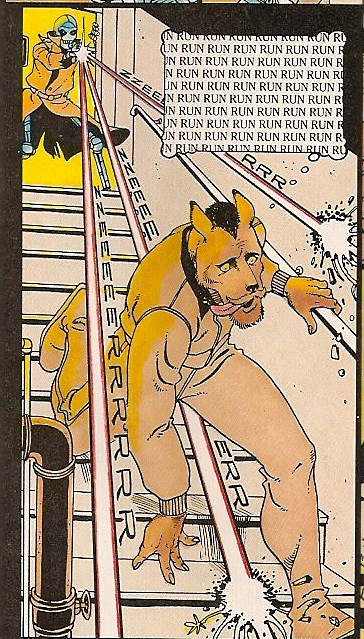
From 1984 to 1986, Fantagraphics published Dalgoda, a science-fiction series about the adventures of an interstellar visitor to Earth in a future that had quite a few disturbing similarities to our own time. I recently backfilled the wholes in in my eight-issue run and re-read the whole story. Here's the 5 x 5:


1. Jan Strnad and Dennis Fujitake are two of my favorite creators. Strnad wrote the fantastic ERB-Wodehouse mashup Dinosaur Rex (illustrated by Henry Mayo) and Fukitake illustrated the back-up story in that book, what is perhaps my all-time favorite comic book story, Dragons of Summer (written by William Messner-Loebs). In Dalgoda, we get these two great talents working together, and that alone is the price of admission.


2. Strnad gives us the titular canine alien and plays with his dogginess without ever making it trite or predictable. All of the cast members (except maybe one villainy-villain) are complex and multi-faceted: the human hero/partner has some less-admirable qualities, the government agents are not faceless drones, the lawyers are not amoral caricatures - even "The Girl" is not at all stereotypical. Heck, Gunner is more "The Sidekick" and screw the gender roles.


3. Fujitake's detailed art is a great accompaniment to Strnad's layered writing. His action scenes are dynamic and clear, but where he shines is in revealing character - the expressions and body languages of the main characters, the supporting characters, and even the extras all convey mood, emotion, information, and even plot cogently and beautifully. I have never encountered a more real world in a comic book than one Fujitake has created.


4. Dalgoda is, of course, a sci-fi epic, and the series gives us a fully realized world, with consistent explanations for its inconsistent technology, a logical premise about interstellar travel that pays attention to both Einsteinian physics and quantum mechanics, and a plot with stakes high enough to make us care about the mission, the maguffin(s), and the heroes.


5. What was ultimately disappointing about this re-read is that the story leaves us in media res; not exactly at a cliffhanger, but with no resolution as of yet. There was a follow-up Dalgoda series, Flesh and Bones; I did not read that at the time and will have to seek it out now. I don't think there's a collected Dalgoda of any sort, but if you ever get a chance to read these, jump at it.

PS: There was some kind of fantasy back-up feature in some of the issues but I ignored it then and now...